


If you’re researching a hair transplant in Austin, a reasonable starting budget is roughly $4,000 to $15,000 for many procedures based on pricing currently published by Austin-area practices. Smaller procedures can cost less. Larger or more complex cases can cost more. [1] [2] [3] [4]
That is not an official Austin average. There isn’t one. Hair-transplant practices price surgery differently, and your eventual quote will depend on factors such as how many grafts you need, whether you have FUE or FUT, the complexity of your hairline and donor area, the surgeon and surgical team, and what the quote actually includes.
There’s another cost worth understanding before treating a transplant like a one-time purchase: hair transplantation can replace coverage, but it doesn’t necessarily stop the hair-loss process. Native hair that was not transplanted may continue thinning. The American Academy of Dermatology notes that hair-loss medication may be recommended after a transplant because hair loss and thinning can continue. [5]
The transplant may be permanent. Your hair-loss problem may not be.
Before comparing procedures by price, it helps to understand whether your goal is to preserve existing hair, improve viable hair, or replace lost coverage. Our complete guide to men’s hair loss and treatment options explains that framework.
What Does a Hair Transplant Cost in Austin Right Now?
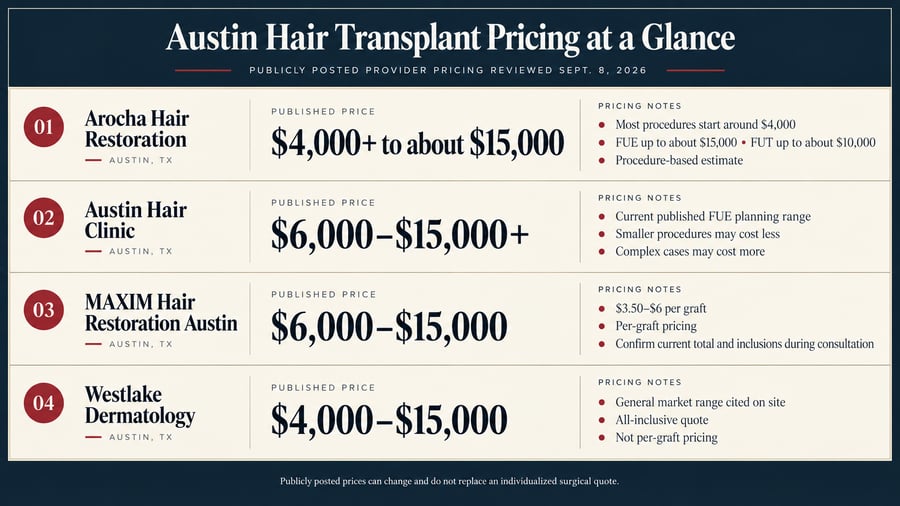
We reviewed publicly available pricing from Austin-area hair-transplant practices on September 8, 2026. These are published figures, not quotes for a particular patient, and pricing can change.
| Austin provider | Publicly stated pricing | Pricing model / note |
|---|---|---|
| Arocha Hair Restoration | Most procedures start around $4,000. Arocha says FUE can average up to $15,000, while FUT typically averages up to $10,000. [1] | Final pricing varies with procedure type, graft count, treatment area and treatment plan. |
| Austin Hair Clinic | Publishes a current FUE planning range of roughly $6,000 to $15,000 or more. [2] | Smaller procedures may cost less; extensive restoration, repair work or advanced technology can cost more. |
| MAXIM Hair Restoration Austin | Publishes approximately $6,000 to $15,000 and $3.50 to $6 per graft, depending on complexity. [3] | Per-graft pricing. Confirm the current total and inclusions during consultation. |
| Westlake Dermatology | Westlake does not publish a fixed procedure price for its own cases. Its site cites a general market range of $4,000 to $15,000. [4] | Westlake says it provides an all-inclusive procedure quote rather than per-graft pricing. |
Several Austin practices advertise complimentary or free consultations, but an initial consultation and a surgical quote are not the same thing. Ask whether any diagnostic, facility, anesthesia, medication, postoperative or follow-up costs sit outside the quoted procedure price.
Financing should also be separated from price. A monthly-payment advertisement tells you how a procedure might be financed; it does not tell you what the procedure costs in total.
How Do Austin Hair-Transplant Prices Compare With the Rest of the U.S.?
Austin appears to be broadly in line with national pricing, although the available data is not precise enough to say Austin is definitively cheaper or more expensive.
CareCredit’s 2026 cost study estimates an average U.S. cost of $5,675 for FUT and $6,344 for FUE. Its Texas estimates are $5,600 for FUT and $6,259 for FUE. [6]
Those figures are useful benchmarks, not price lists. Austin practices publicly advertise cases that extend well beyond those averages as graft counts and complexity increase. The practical takeaway: your individual treatment plan is likely to matter more than your ZIP code.
Why Can Two Hair-Transplant Quotes Be Thousands of Dollars Apart?
Hair-transplant pricing isn’t as simple as buying a fixed number of identical grafts. Several variables can move the total.
Graft count
The larger the area being restored and the greater the desired coverage, the more grafts may be required. But a graft is not the same thing as one hair. Follicular units are the small groups in which hair naturally grows, and a graft can contain more than one hair.
FUE vs. FUT
The way donor grafts are harvested can affect price. FUE often costs more because follicular units are excised individually, although the actual difference varies by practice and treatment plan. [9]
Your donor area and treatment complexity
A surgeon has to consider how much usable donor hair you have, its density and characteristics, the size of the area being restored and how much donor supply should be preserved for the future. Revision procedures can be more complicated than first-time cases.
Surgeon and surgical team
Hair transplantation combines medical judgment, surgery and aesthetic design. The AAD emphasizes that outcomes depend substantially on the surgeon selected. [5]
What the quote includes
Depending on the practice, the quoted total may or may not include:
- preoperative evaluation;
- local anesthesia;
- medications and postoperative supplies;
- facility-related fees;
- follow-up appointments;
- adjunctive hair-loss treatments; or
- later touch-up work.
When comparing clinics, ask for the total expected price and exactly what that price includes.
How Many Hair Grafts Will You Need?
This is one area where an online calculator can create more confidence than accuracy.
The 2025 International Society of Hair Restoration Surgery Practice Census found that participating physicians reported an average of 2,100 grafts in a typical FUT case and 2,262 grafts in a typical FUE case. The average first procedure involved 2,347 grafts. [7]
Those are survey averages, not recommendations for you.
One man may need considerably fewer grafts to address a receding hairline. Another may need several thousand to improve coverage across larger areas of the scalp. Graft requirements can vary with the size and pattern of loss, donor density, hair diameter, curl, hair-to-scalp contrast, existing density, desired coverage and the surgeon’s expectations for future loss.
A useful consultation should answer more than, “How many grafts can we transplant?” A better question is:
How many grafts should we use now while protecting my options later?
Donor Hair Is a Limited Resource
This is one of the most important parts of hair-transplant planning—and one of the easiest to overlook when you’re focused on price.
A transplant does not create new follicles. It redistributes follicles you already have. ISHRS describes donor hair as finite and non-renewable: once donor follicles are removed and transplanted, they are not replaced in the original donor area. [8]
“Patients have a supply of donor hair that is finite and it’s a non-renewable resource.”
— International Society of Hair Restoration Surgery [8]
That matters because hair loss can continue. Using a large share of donor hair to create an aggressive result today may leave fewer options if more native hair disappears later.
More grafts isn’t automatically a better deal. Good surgical planning has to balance the result you want now with the donor supply you may need in the future.
Additional Reading: Men’s Hair Loss: Causes, Early Signs, Treatments & What Actually Works
Does FUE Cost More Than FUT?
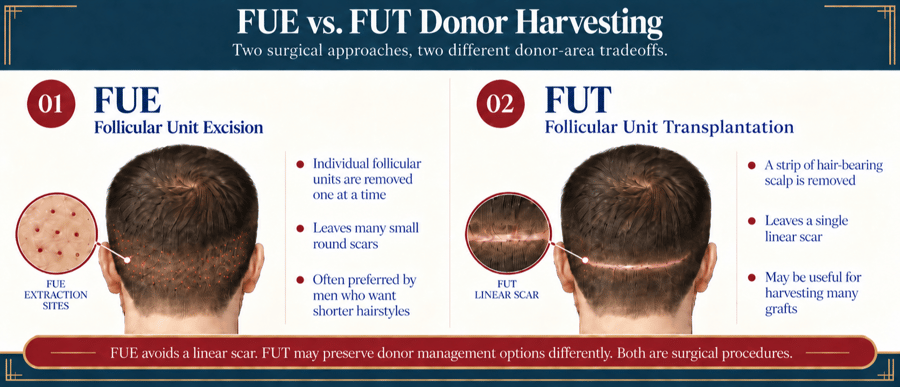
Often, but not universally.
Both are hair-transplant surgeries. The main difference is how the follicular-unit grafts are obtained from the donor area.
FUE: Follicular Unit Excision
ISHRS uses the term Follicular Unit Excision for FUE, although you will still frequently see “Follicular Unit Extraction” in consumer marketing.
With FUE, follicular units are individually removed from the donor area with a small round punch. Because there is no strip incision, FUE avoids the long linear donor scar associated with FUT.
But FUE is not scarless, and it is still surgery. ISHRS notes that thousands of small excisions constitute an invasive surgical procedure and that FUE generally leaves small round scars in the donor area. [9]
FUT: Follicular Unit Transplantation
With FUT, a strip of hair-bearing scalp is surgically removed from the donor area. The strip is then dissected under magnification into follicular-unit grafts for transplantation. The donor incision is closed, leaving a linear scar. [9]
FUT can be useful when a surgeon wants to harvest a substantial number of grafts while managing donor supply in a particular way. FUE may make more sense for other patients, including some men who prefer shorter hairstyles.
There is no universally superior choice. The better question is which harvesting strategy makes sense for your donor supply, hairstyle, goals and long-term pattern of hair loss.
What Should You Compare Besides Price?
Price matters. A hair transplant is a significant out-of-pocket purchase for most men. But choosing entirely on price can be expensive later.
The AAD recommends choosing a physician who understands hair loss and performs hair transplantation regularly. ISHRS also urges patients to ask who will evaluate the hair loss, who will participate in the surgery, and what training, licensure and experience those individuals have. [5] [10]
Questions worth asking include:
- Who diagnoses my hair loss and determines whether I’m a surgical candidate?
- Who designs my hairline?
- Who harvests the grafts?
- Who creates the recipient sites?
- How many grafts are you recommending, and why?
- How will you avoid overharvesting my donor area?
- What happens if my native hair continues thinning?
- Can I see results from men with a similar pattern and hair type?
- What does the quoted price include?
- What follow-up care is provided?
The most expensive surgeon is not automatically the best. The cheapest graft is not automatically the bargain either.
Is a Hair Transplant Really “One and Done”?
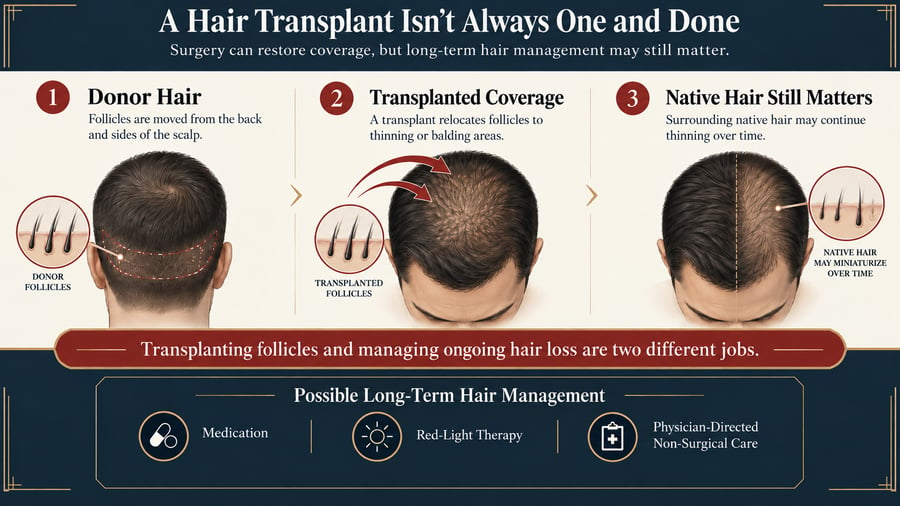
Sometimes one procedure produces the result someone wants. But a hair transplant should not automatically be viewed as a one-and-done solution to hair loss.
In the 2025 ISHRS Practice Census, 67.3% of participating physicians reported an average of one procedure to achieve the desired restoration result. Across respondents, the mean was 1.5 procedures per patient, with a median of one. [7]
That statistic is not a failure rate and not a maintenance rate. Additional procedures may be planned from the beginning, used to add density, address a different area, respond to continued loss or reflect changing goals.
The bigger long-term issue is what happens to the hair that wasn’t transplanted.
A transplant moves follicles. It doesn’t stop progressive hair loss.
For men with androgenetic alopecia, genetically susceptible native follicles can continue to miniaturize after surgery. The AAD therefore notes that a dermatologist may recommend hair-loss medication after a transplant to help slow additional thinning and preserve the overall result. [5]
“Medicine helps because hair loss and thinning can continue, even after a hair transplant.”
— American Academy of Dermatology [5]
Depending on the individual, long-term management may include medication, red-light therapy, other nonsurgical treatments or another transplant later.
If you want a deeper look at one common maintenance medication, see Flycatcher’s guide to finasteride side effects, libido and dutasteride.
Where does red-light therapy fit after a hair transplant?
Low-level light therapy—also called LLLT, laser therapy or photobiomodulation—is used as a nonsurgical treatment for hair loss. A 2025 systematic review and meta-analysis of 38 studies found a significant improvement in hair density with LLLT versus placebo among patients with androgenetic alopecia. [12]
The AAD also notes that some studies suggest low-level laser therapy may help stimulate healing and hair growth after a hair transplant, while emphasizing that repeated treatments are required and more research is needed. [11]
That does not mean red light has been proven to improve the survival rate of newly transplanted grafts, and it should never override a transplant surgeon’s postoperative instructions. A better way to think about it is as one potential part of ongoing hair management, particularly for supporting viable native hair that remains.
Flycatcher does not perform hair-transplant surgery, but we do offer red-light therapy and other nonsurgical hair-restoration options for men interested in maintaining and supporting their hair before or after transplantation. Post-transplant patients should follow their surgeon’s guidance on when it is appropriate to begin or resume light-based treatment.
Additional Reading: Red Light Therapy After a Hair Transplant: Science, Timeline & Results
The useful budgeting question therefore isn’t only, “How much does the surgery cost?”
It’s also: “What might maintaining the rest of my hair cost over the next five, ten or twenty years?”
Hair Transplant vs. Non-Surgical Hair Restoration: Different Jobs
This is where comparing price alone becomes misleading.
A hair transplant relocates follicles. It takes viable donor follicles from one part of the scalp and uses them to create coverage somewhere else.
Non-surgical hair restoration primarily works with viable follicles that are still present. Depending on the treatment, the goal may be to slow loss, preserve existing hair, improve thickness or stimulate growth from follicles that can still respond.
They are not simply two differently priced versions of the same treatment.
A man with a longstanding bald area may need transplantation if his goal is to place meaningful coverage where viable follicles are no longer present. A man who is thinning but still has considerable viable hair may have more to gain initially from preserving and improving what he still has. Some men ultimately use both: transplantation for coverage and nonsurgical treatment to manage the hair around it.
If surgery isn’t where you want to start, we’ve also broken down the cost of non-surgical hair restoration in Austin, from prescription treatment and PRP to red light therapy and comprehensive programs.
Additional Reading: How Much Does Non-Surgical Hair Restoration Cost in Austin?
When Might Non-Surgical Hair Restoration Make Sense First?
Not everyone researching transplant prices needs surgery right now.
The AAD notes that some younger men may be advised to wait and begin medical treatment before undergoing transplantation. Surgical candidacy also requires enough healthy donor hair and the ability to grow hair in the intended recipient area. [5]
A nonsurgical-first approach may be worth exploring when significant viable hair remains, thinning is still progressing, preserving existing hair is the immediate priority, the cause of the hair loss still needs to be clarified, donor supply is limited, or you simply are not ready for surgery.
The opposite is also important to say plainly: nonsurgical treatment cannot simply create a new supply of follicles in a bald area. That is one reason hair transplantation remains an important option for appropriately selected patients.
The Bottom Line on Hair-Transplant Cost in Austin
If you’re establishing a realistic budget, roughly $4,000 to $15,000 is a useful starting range based on publicly posted Austin-area pricing reviewed in September 2026. It is not an official Austin average, and individual quotes can fall outside that range. [1] [2] [3] [4]
But the smartest comparison goes beyond dividing a quote by its number of grafts. Look at how many grafts you actually need, FUE versus FUT, your donor supply, who is performing the procedure, what the quote includes, your likely future pattern of hair loss and what you may need to do to maintain the overall result.
A well-planned hair transplant can provide long-lasting, natural-looking coverage in an appropriate candidate. [5]
Just remember: restoring missing coverage and managing ongoing hair loss are two different jobs.
Want to Understand Your Non-Surgical Options?
Flycatcher does not perform hair-transplant surgery. If you want to determine whether you are a good surgical candidate or obtain an accurate transplant quote, that conversation should happen with an experienced hair-transplant physician.
If you want to better understand your current hair and scalp health, explore nonsurgical options, or discuss ongoing hair maintenance before or after transplantation, Flycatcher offers a complimentary Scalp & Hair Health Consultation.
Learn more about Flycatcher’s non-surgical hair-restoration approach, or call or text (737) 239-0112 to schedule your consultation.
Flycatcher is located on Highway 71 in the Spicewood/Bee Cave area, about three miles west of the Galleria, serving Lakeway, Bee Cave, Spicewood and the greater Austin area.
Not ready for a consultation? Start with Flycatcher’s Two-Minute Hair Check.
References
- Arocha Hair Restoration. Hair Transplant in Austin, TX. Pricing reviewed September 8, 2026.
- Austin Hair Clinic. What Does an FUE Hair Transplant Cost in Texas? Published September 8, 2026.
- MAXIM Hair Restoration. Cost of a Hair Transplant in Austin, TX. Pricing reviewed September 8, 2026.
- Westlake Dermatology. Hair Transplant in Austin. Pricing model reviewed September 8, 2026.
- American Academy of Dermatology Association. A Hair Transplant Can Give You Permanent, Natural-Looking Results.
- CareCredit. Hair Transplant Cost and Procedure Guide. July 24, 2026.
- International Society of Hair Restoration Surgery. 2025 Practice Census Results. May 2025.
- International Society of Hair Restoration Surgery. Top 5 Things to Know About Hair Transplantation.
- International Society of Hair Restoration Surgery. All You Need to Know About Hair Transplant Procedures.
- International Society of Hair Restoration Surgery. Consumer Advocacy: Questions Patients Should Ask.
- American Academy of Dermatology Association. Hair Loss: Diagnosis and Treatment.
- Perez SM, Vattigunta M, Kelly C, Eber A. Low-Level Laser and LED Therapy in Alopecia: A Systematic Review and Meta-Analysis. Dermatologic Surgery. 2025;51(2):179-183.
