


Morpheus8 gets described in a lot of ways: advanced microneedling, a skin-tightening treatment, even a “nonsurgical facelift.”
That last description is where things start getting slippery.
Morpheus8 can improve certain kinds of skin laxity, texture, acne scarring and age-related skin changes. But it does not do what surgery does, and it is not automatically the right treatment simply because someone wants tighter or better-looking skin.
Maybe your jawline looks a little softer than it did five years ago. Maybe the skin under your chin or along your neck has started looking looser. Or perhaps your bigger concern is acne scarring, rough skin texture or pores that seem increasingly obvious.
Those are different problems. Morpheus8 may help several of them, but not necessarily in the same way—or to the same degree.
Here is what RF microneedling actually does, what it can realistically improve, what treatment and recovery are like, and where its limits begin.
What Is RF Microneedling?
Traditional microneedling uses very small needles to create controlled microscopic injuries in the skin. Those injuries trigger a wound-healing response that includes remodeling of collagen and other components of the skin.
Radiofrequency microneedling adds another component: controlled heat.
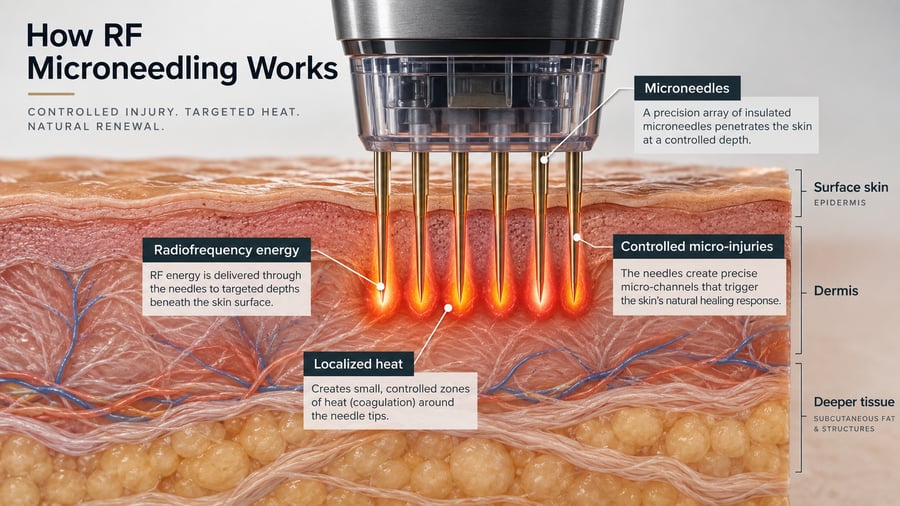
The microneedles enter the tissue and deliver radiofrequency, or RF, energy below the skin's surface. RF energy produces localized heating around the electrodes, creating both mechanical and thermal injury.
That combination is what separates RF microneedling from traditional microneedling.
What Is Morpheus8?
Morpheus8 is one specific RF microneedling platform made by InMode.
The device uses arrays of small electrodes to deliver RF energy into tissue at selected treatment depths.
You'll often see a lot of marketing around how “deep” Morpheus8 can go. Different applicators and tips have different capabilities, so there is no single depth that defines every treatment.
More importantly, depth is not a scorecard. Going deeper does not automatically mean getting a better result.
The appropriate depth and energy depend on the treatment area, the anatomy beneath it and the goal of treatment.
The videos below show a comparison between a SkinPen microneedling treatment and treatment with Morpheus8 RF microneedling.
What Does the Radiofrequency Energy Actually Add?
With traditional microneedling, the needles themselves create the controlled injury.
With RF microneedling, those needles also deliver energy that heats targeted tissue. That thermal effect creates small zones of controlled coagulation, followed by healing and remodeling over time.
Recent systematic reviews of RF microneedling have found improvements in measures such as skin texture and tightening.[1]
That does not mean every RF microneedling device or protocol produces identical results. Studies use different machines, depths, energy settings and treatment schedules.
So broad claims about “RF microneedling” should not automatically be treated as proof of what every device can accomplish.
What Can Morpheus8 Realistically Improve?
“Skin rejuvenation” is a convenient phrase, but it lumps together several very different problems.
It is more useful to look at them individually.
Mild Skin Laxity and Firmness
Skin laxity is one of the most common reasons men become interested in Morpheus8.
Perhaps the edge of the jaw isn't quite as crisp anymore. The skin beneath the chin looks slightly looser. Or the neck is beginning to show changes that weren't particularly noticeable a few years ago.
RF microneedling has evidence supporting improvement in mild-to-moderate skin laxity and firmness.
A prospective study examining RF microneedling of the lower face, jawline and neck reported improvement following treatment, with patients followed for as long as six months.[2]
But the operative word is improvement.
Morpheus8 can remodel tissue. It cannot physically reposition sagging facial structures or remove substantial loose skin the way surgery can.
Acne Scars
Acne scarring is another area where RF microneedling has meaningful clinical evidence.
A 2025 systematic review examined 16 studies involving 481 patients and concluded that fractional RF microneedling is likely effective as a stand-alone treatment for facial acne scarring. The authors also noted that more randomized research is needed to determine ideal treatment parameters.[3]
That's an important qualification because “acne scars” are not all the same.
Rolling scars, boxcar scars, ice-pick scars and tethered scars behave differently. Scar depth and underlying structure matter. Some scars may respond nicely to RF microneedling, while others may be better addressed with another treatment or a combination approach.
The better question is not simply whether Morpheus8 treats acne scars.
It's what kind of scars you have and whether RF microneedling is a good tool for them.
Flycatcher has a broader guide to acne-scar treatments for men, including SkinPen, Morpheus8 and laser options. You can also learn more about our approach to acne and acne-scarring treatment for men.
Skin Texture
RF microneedling can also improve uneven or rough-looking skin texture.
For many men, this may matter more than chasing every fine line. Smoother, more even skin can make the face look healthier and better maintained without making it look “done.”
A recent systematic review of RF microneedling for facial rejuvenation found skin-texture improvement to be one of the recurring outcomes across published studies.[1]
Fine Lines
Fine lines may improve as the skin remodels after treatment.
But the cause of the line matters.
A superficial line related partly to skin quality is different from a deep crease created by years of facial movement. It is also different from a fold caused by volume loss or changes in the underlying facial structure.
Morpheus8 may improve the skin itself.
It does not solve every reason a wrinkle exists.
Enlarged-Looking Pores
RF microneedling may also reduce the appearance of enlarged pores in some patients.
Pores do not literally open and close. Treatments that improve surrounding skin texture may make them appear less prominent, but promising to permanently “close pores” oversells what is happening.
Jawline and Neck
This is where Morpheus8 gets especially interesting for men—and where expectations matter most.
A softer jawline can result from loose skin, fat beneath the chin, changing facial volume, underlying bone structure, deeper tissue descent or some combination of those factors.
RF microneedling can address the skin and targeted underlying tissue. Research supports its use for mild laxity of the lower face, jawline and neck.[2]
But if significant loose skin, substantial submental fat or deeper structural change is driving the problem, skin tightening alone may not get you where you want to go.
Our skin-tightening and jawline treatment guide for men looks at the broader range of problems that can contribute to changes around the lower face and neck.
Where Morpheus8 Has Limits
Knowing what a treatment cannot do can be just as useful as knowing what it can.
Morpheus8 Is Not a Facelift
A facelift surgically repositions deeper facial tissues and removes or redrapes excess skin.
Morpheus8 doesn't.
It may improve firmness and mild laxity, but it should not be expected to reproduce surgical lifting.
“Nonsurgical facelift” may make a good headline. It isn't a particularly useful way to set expectations.
It Cannot Eliminate Major Loose Skin
Early looseness and substantial hanging skin are different problems.
RF microneedling may improve mild or moderate changes, but there is a point at which an energy-based treatment cannot substitute for physically removing or repositioning tissue.
It Does Not Replace Lost Facial Volume
If volume loss is making the cheeks look hollow or creating deeper folds, tightening the overlying skin may not address the main problem.
Likewise, if fat beneath the chin is obscuring the jawline, skin tightening alone may leave you disappointed.
It Is Not Primarily a Pigmentation Treatment
If your main concern is brown spots, sun damage, redness or uneven pigmentation, another technology may make more sense.
Morpheus8 is a useful tool. It is not an all-purpose skin treatment.
Morpheus8 vs. Traditional Microneedling: The Short Version
Morpheus8 and traditional microneedling are related, but they are not the same treatment.
Traditional microneedling creates controlled mechanical micro-injuries using needles.
RF microneedling creates those needle injuries and adds radiofrequency energy to heat targeted tissue.
That changes the treatment's capabilities, intensity and risk profile.
Neither approach is automatically better.
We'll cover that decision in depth in our separate guide to RF Microneedling vs. Traditional Microneedling: What's the Difference?
What Does Morpheus8 Feel Like?
Morpheus8 is normally performed after topical anesthetic has been applied and given time to take effect.
During treatment, the handpiece is placed against the skin, the needles enter the tissue and RF energy is delivered.
How uncomfortable that feels depends on treatment depth, energy, location and individual sensitivity.
And despite some marketing descriptions, numbing does not necessarily make RF microneedling painless.
In one prospective study of the lower face, jawline and neck, patients reported an average pain score of about 5.6 on a 10-point scale.[2]
That doesn't mean your treatment will feel exactly the same. It does give a more realistic picture than simply calling the procedure “comfortable.”
What Does Morpheus8 Downtime Really Look Like?
“Downtime” can mean two different things:
Can I go back to work?
and
Will nobody be able to tell that something happened to my face?
Those are not necessarily the same question.
At Flycatcher, we tell men to expect some visible evidence that their skin has been treated. Redness, swelling, tenderness, temporary roughness and small pinpoint marks can all be part of the recovery process.
How noticeable they are—and how long they last—depends on treatment intensity, the area treated and the individual.
Some men may feel perfectly capable of working or going about normal activities while their skin still looks obviously treated.
So we would not describe Morpheus8 as having “no downtime.”
A better expectation is that normal activity may resume relatively quickly for many patients, while visible recovery can take several days.
If you have a wedding, major presentation or close-up photo shoot coming up, build in some margin.
When Do Morpheus8 Results Appear?
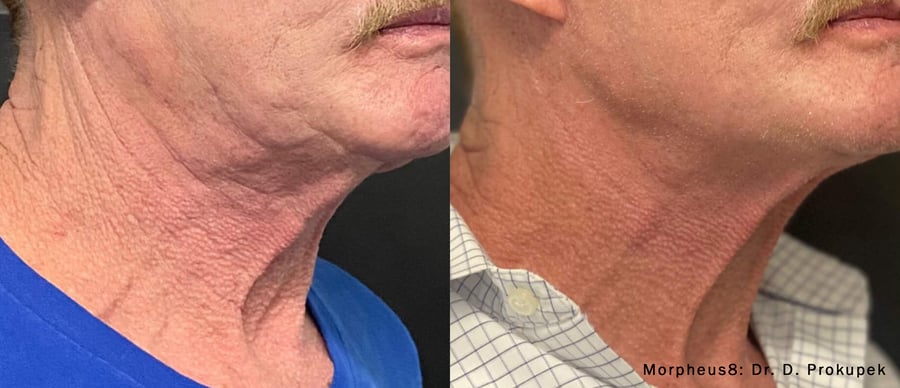
Morpheus8 is not a treatment that should be judged the next morning.
Immediately afterward, redness and swelling may temporarily change how your face looks. That's the treatment reaction—not your final result.
Early improvements may become noticeable over the following weeks, while more meaningful changes develop as healing and tissue remodeling continue.
Clinical RF-microneedling studies often evaluate patients months after treatment rather than days later. The lower-face and neck study discussed earlier included follow-up at 90 and 180 days.[2]
The treatment happens in an appointment. The biological response happens over time.
At Flycatcher, we recommend a series of three Morpheus8 treatments. That gives the skin time to respond and remodel between sessions while allowing us to evaluate progress over the course of the series.
The exact spacing and treatment settings can vary depending on the concern, treatment area and how your skin responds.
How Long Do Morpheus8 Results Last?
There isn't a universal expiration date when RF microneedling suddenly “wears off.”
The remodeling produced after treatment doesn't disappear on a predetermined day, but your skin continues aging. Sun exposure, genetics, lifestyle and normal biological changes continue too.
That's why we don't think maintenance should automatically mean scheduling the same treatment every year simply because 12 months have passed.
Some men may eventually benefit from additional treatment. Others may be better served by doing something different as their skin and priorities change.
Maintenance should respond to what your skin needs—not the anniversary date of your last appointment.
Is Morpheus8 Safe?
Most people undergoing RF microneedling experience temporary treatment effects such as redness, swelling, tenderness and sensitivity.
But that is not the entire safety picture.
In October 2025, the FDA issued a safety communication after receiving reports of serious complications associated with certain uses of RF microneedling devices.
Reported complications included:
- burns
- scarring
- fat loss
- disfigurement
- nerve damage
Some reported injuries required medical treatment or surgical repair.[4]
That does not mean everyone receiving RF microneedling faces these complications, nor does the FDA communication tell us how frequently they occur.
It does mean they are real enough that the FDA specifically warned patients and providers about them.
The FDA also emphasizes that RF microneedling is a medical procedure—not simply a cosmetic facial treatment.[4]
That makes the person performing the treatment especially important.
Why Your Morpheus8 Provider Matters
The device does not make all of the treatment decisions.
The person holding it does.
A provider decides treatment depth, RF energy, treatment pattern, number of passes and whether one part of the face or neck should be approached differently from another.
Those decisions matter because the cheek, jawline and neck do not all have identical tissue thickness or anatomy.
The safety of RF microneedling depends partly on the device and partly on the judgment of the person using it.
The FDA specifically recommends seeking care from a licensed healthcare provider with training and experience using RF microneedling devices.[4]
Don't be embarrassed to ask what that experience actually looks like.
Three Questions We'd Definitely Ask Before RF Microneedling
1. How many RF microneedling or Morpheus8 treatments have you personally performed?
“Experienced” can mean very different things to different people. Ask for something concrete.
Someone who performs the treatment regularly has had more opportunity to see different skin types, anatomy, treatment responses and healing patterns.
2. What training have you received specifically on this device?
General aesthetics experience and device-specific training are not identical.
Ask whether the person treating you has been trained specifically on Morpheus8 or whichever RF-microneedling platform is being used.
3. What adverse reactions or complications have you actually seen, and what did you do about them?
This may be the most revealing question.
Redness, swelling and temporary discomfort are expected reactions. An experienced provider should understand the difference between normal healing and something that needs attention.
A useful follow-up is:
“If something doesn't look or feel right after treatment, who evaluates me?”
You want to know that before there's a problem.
Experience isn't simply knowing which buttons to push.
It is understanding anatomy, knowing when to modify a treatment, recognizing normal healing and knowing when something is not normal.
Can Morpheus8 Be Used on Darker Skin?
RF energy does not rely on selectively targeting melanin in the way many lasers and IPL systems do.
That can make RF microneedling useful across a broad range of skin tones.
But “Morpheus8 is safe for every skin type at every setting” is too simplistic.
Morpheus8 labeling states that at energy levels greater than 62 mJ per pin, use of the applicator is limited to Fitzpatrick skin types I through IV.[5]
So skin tone doesn't necessarily determine whether RF microneedling is an option.
It can affect how the treatment is performed.
Who Should Avoid or Delay Morpheus8?
A proper consultation should include your health history, medications, skin condition, previous procedures and anything else that could affect healing or treatment safety.
Active infections or significant inflammation in the treatment area, certain medical conditions, medications that affect bleeding or healing, implanted medical devices and other factors may change whether treatment is appropriate or whether it should be postponed.
This is also one place where outdated internet advice can create problems.
For example, blanket rules surrounding medications such as isotretinoin have evolved as evidence has changed. Rather than stopping a medication because a med-spa blog told you to, discuss it with the healthcare professionals responsible for your care.
Do not stop a prescription medication—including a blood thinner—just to qualify for an aesthetic treatment unless the clinician who manages that medication tells you to.
Sometimes the safest treatment decision is simply to wait.
So, Is Morpheus8 Right for You?
Morpheus8 makes the most sense when RF microneedling actually fits the concern.
For one man, that may be acne scars he's carried since his twenties.
For another, it may be rougher-looking skin and increasingly noticeable texture.
For someone else, it may be early loss of firmness around the jawline or neck.
And sometimes Morpheus8 isn't the best tool for the job.
That's useful information too.
At Flycatcher, we work specifically with men in the Austin area. A consultation starts with what bothers you, what kind of improvement is realistic and how much downtime you're comfortable with.
From there, we can determine whether RF microneedling makes sense or whether another approach is more appropriate.
Want to find out whether Morpheus8 makes sense for your skin? Schedule a consultation with Flycatcher or call/text (737) 239-0112.
References
1. Kumar N, Suh DH, Lee SJ, et al. Radiofrequency Microneedling for Facial Rejuvenation: A Systematic Review. Journal of Cosmetic Dermatology. 2026;25(4):e70845. PubMed.
2. Nguyen L, Blessmann M, Schneider SW, Herberger K. Radiofrequency Microneedling for Skin Tightening of the Lower Face, Jawline, and Neck Region. Dermatologic Surgery. 2022;48(12):1299–1305. PubMed.
3. Niaz G, Ajeebi Y, Alshamrani HM, Khalmurad M, Lee K. Fractional Radiofrequency Microneedling as a Monotherapy in Acne Scar Management: A Systematic Review of Current Evidence. Clinical, Cosmetic and Investigational Dermatology. 2025;18:19–29. PubMed.
4. U.S. Food and Drug Administration. Potential Risks with Certain Uses of Radiofrequency (RF) Microneedling — FDA Safety Communication. October 15, 2025. FDA.
5. U.S. Food and Drug Administration. The InMode System with the Morpheus8 Applicators — K231790. FDA 510(k) documentation.
