

A few weeks ago, one of our Unlimited Red Light Membership clients told us a story that felt very Austin.
He was in his stylist’s chair talking about how much he’s been enjoying the low-level laser therapy (LLLT) he’s been doing at Flycatcher—and the hair results he’s started to see. A woman nearby chimed in, confident and well-meaning: “You don’t need to go there, that’s too expensive. Just do a red light sauna at ___.”
If you’ve spent any time around Lakeway, Bee Cave, or the Hill Country Galleria wellness scene, you’ve probably heard some version of that. “Red light” is everywhere right now—saunas, panels, beds, facials, memberships—and it’s easy to assume it’s all interchangeable.
In Austin, a lot of people compare the cost between red light used in low-level laser therapy and red light saunas—but the better comparison is wavelengths, dose, and consistency.
If you’re searching for the best red light therapy in Austin, here’s how to evaluate options for hair loss without getting fooled by marketing terms.
Red Light Therapy vs Red Light Sauna for Hair Growth: What’s the Difference?
Let’s start with the big idea: “red light therapy” is an umbrella term. It can refer to:
- Low-Level Laser Therapy (LLLT) (often hair-focused, scalp-targeted, medical protocols)
- LED panels or beds
- Caps/helmets for home use
- In-clinic light devices that may be designed for a specific treatment goal (hair, skin, recovery)
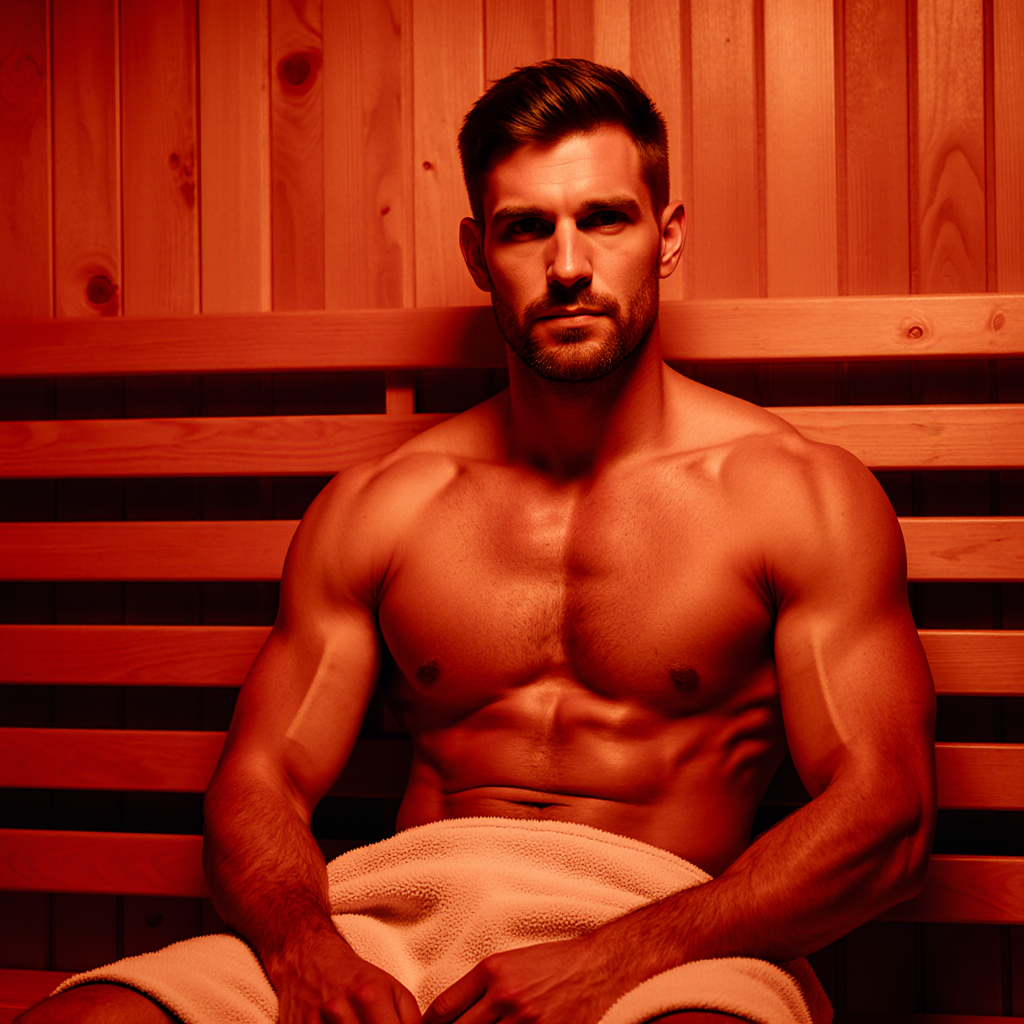
A “red light sauna,” on the other hand, is usually a different experience and a different goal. Many sauna studios emphasize heat + relaxation + sweating, using infrared heaters (near-, mid-, far-infrared), and sometimes add red LEDs as an “enhancement” to the sauna ritual. The red light component may be positioned for general wellness, skin, or recovery rather than a scalp-specific protocol.
Some Lakeway/Bee Cave-area studios do a great job delivering a consistent sauna experience, and many offer memberships. But “sauna + red light” is not the same thing as hair-focused, scalp-dosed LLLT.
Some businesses bundle this as ‘infrared sauna + red light,’ which is why confusion between red light therapy and infrared sauna is so common.
If you’re still figuring out where LLLT fits among the broader options, our guide to men’s hair loss treatments compares it with medications, PRP, microneedling, and transplantation.
How Red Light Therapy for Hair Loss Works (LLLT Explained Simply)
When we’re talking about hair-specific “red light therapy,” what we really mean (clinically) is photobiomodulation—light energy triggering cellular signaling that supports healthier follicle activity.
Here’s the simple version:
- Light → cellular signaling: Specific wavelengths are absorbed by cellular “chromophores” (often discussed in relation to mitochondria), which can support energy production and cell function.
- Scalp environment improves: Many LLLT protocols are designed to support microcirculation, reduce inflammatory signaling, and help follicles function in a healthier environment.
- Hair growth is slow biology: Even when a treatment is working, hair cycles take time. People often notice changes in shedding/stability first, then density/quality later.
- Consistency beats intensity: Hair outcomes typically come from repeating the right dose and delivery method over months—not from “one great session.”
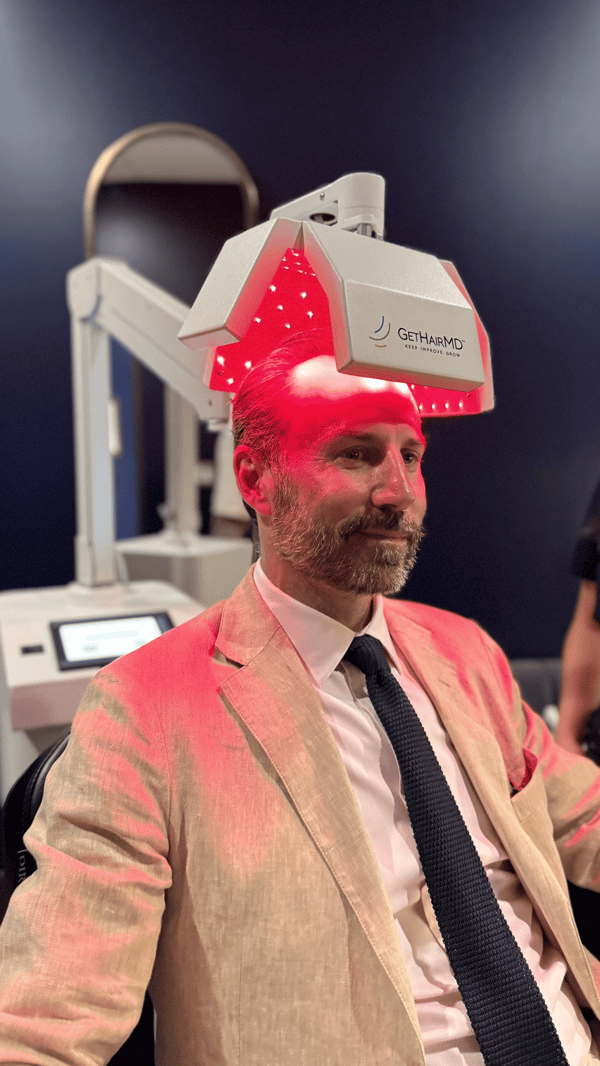
At Flycatcher, our GetHairMD-guided in-office LLLT protocol is designed around repeatable sessions (typically 2 sessions per week for 20–30 minutes for the first three months) using a device that’s FDA-cleared for hair regrowth and built for full scalp coverage with consistent energy distribution. (More on why that matters below.)
Wavelengths for Hair: What ‘Best’ Really Means (660 vs 850 Explained)
A lot of the “red light confusion” comes down to wavelengths. You’ll commonly see:
- Red light in the mid-600 nm range (often marketed as “660”)
- Near-infrared (NIR) in the 800–900 nm range (often marketed as “850”)
Those numbers can matter—but not in the simplistic “850 is deeper so it must be better” way that marketing often implies.
Red light (mid-600s) and hair-focused protocols
For hair, many evidence-based devices and protocols cluster around the visible red range because it’s practical for scalp-targeted photobiomodulation.
Our in-office Clinical Hair Growth Laser used at Flycatcher uses a 650 nm wavelength and coherent lasers in a low-level, non-thermal design—built specifically for reaching follicles and supporting hair regrowth as a Class II, FDA-cleared device.
Near-infrared (800s) and deeper-tissue claims
Near-infrared wavelengths are often promoted for “deeper penetration” and recovery. That can be relevant for certain wellness goals. But deeper isn’t automatically better for hair if the delivery method isn’t actually achieving a scalp-appropriate dose to the follicle consistently, across the areas that are thinning.
Even in medical-grade diode discussions, it’s common to see 650 nm referenced for follicle stimulation and ~808 nm referenced for deeper tissue effects—but the key is how it’s delivered and dosed for the target goal.
The key takeaway
For hair loss, wavelength matters, but it’s only one piece of the puzzle. The real question is:
- Are you getting a repeatable scalp dose?
- Are you getting full coverage (not a few hot spots and a lot of missed scalp)?
- Can you realistically do it often enough for long enough?
That’s why ‘best’ isn’t just a wavelength—it’s a repeatable protocol you can stick with.
LED vs Laser Red Light Therapy: Does It Matter for Hair Loss?
This is where people get trapped in a tech debate: LED vs laser.
Here’s the practical answer: don’t wage a tech war—focus on what you can verify.
Lasers and LEDs behave differently. Lasers are typically discussed as more coherent and monochromatic (single-wavelength, in-phase light), which can support more targeted delivery. LEDs can still be useful, but the real-world outcome depends on wavelength accuracy, irradiance at the scalp, treatment geometry, and how consistently you actually do it.
For hair, what tends to separate “this might help” from “this is a real protocol” is:
- Scalp coverage (are you hitting the entire thinning zone consistently?)
- Repeatability (same dose, same distance, same duration)
- Comfort and adherence (can you do this 2x/week for 3 months?)
GetHairMD’s Clinical Hair Growth Laser is designed around proprietary dispersion/coverage concepts to create a consistent “field” of laser energy and reduce the gaps/shadows that can happen with more directional point beams.
If you’re comparing ‘laser’ vs ‘LED’ providers in Austin, ask them for specs and protocols—not just brand names.
The Specs That Actually Predict Results: Irradiance, Distance, Dose
If you want to cut through marketing, get curious about three things:
- Irradiance (power density): how much light energy is reaching the scalp surface (commonly expressed as mW/cm²)
- Distance: irradiance drops as you move farther away; “in the room” isn’t the same as “at the scalp”
- Dose (fluence): a simple way to think about it is irradiance × time (how much energy delivered over a session)
This matters because two services can both advertise “red light therapy” but deliver totally different real-world dosing—especially if one is designed for whole-body ambiance and the other is designed for scalp-specific dosing.
Checklist: Ask any provider
-
What wavelengths are used?
-
What is irradiance at the scalp and at what distance?
-
Session length + weekly frequency?
-
How do they ensure scalp coverage (parting/sections)?
-
Eye protection + standardized protocol?
Red Light Therapy Panel vs Sauna: Which Makes Sense for Hair Loss?
Let’s be fair: sauna studios aren’t “bad.” They’re just usually designed for a different goal.
In the Lakeway / Bee Cave area, many wellness businesses position red light as part of a broader recovery menu—often bundled with infrared sauna, cryotherapy, IV options, compression, etc. Examples in Bee Cave include Restore Hyper Wellness, Perspire Sauna Studio, CryoFit, Alive and Well, and others.
A sauna may be a fit if you want:
- Relaxation and “reset” time
- Heat + sweating as part of your routine
- A whole-body wellness ritual you’ll actually do consistently
Targeted red light/LLLT is usually a better fit if your goal is:
- Scalp-focused dosing (your follicles don’t care about vibes—only delivered energy)
- Repeatability (same distance, same duration, same coverage)
- Hair-specific outcomes supported by a device built and cleared for that purpose
This is why unlimited red light therapy and spa memberships in the Austin area are so popular—consistency is the whole game.
Bottom Line: How to Choose the Right Option
If your goal is hair growth, here’s the simplest decision rule:
- Choose scalp-targeted delivery (not just general red light exposure)
- Choose transparent specs (wavelength + irradiance at a defined distance)
- Choose a schedule you’ll actually keep (2x/week is realistic for many people; hair is a months-long project)
At Flycatcher, our Unlimited Red Light Membership is designed around that reality: hair outcomes come from repeatable dosing + adherence, and we make it easy to stay consistent with a hair-specific, GetHairMD-guided LLLT protocol.
If you’re curious, you can try our Unlimited membership FREE for 15 days—and decide with your own eyes whether it’s the right fit for your hair (and schedule).
Whether you choose a package or a membership in Austin, make sure you’re paying for a protocol that matches your hair goals—not just a trendy wellness experience.
