


Maybe your jawline isn't as sharp as it used to be. Your neck has started to sag. Or you've lost weight, but the skin around your stomach doesn't look quite the way you expected.
Search for a solution and you'll find plenty of promises: radiofrequency, ultrasound, microneedling, fat freezing, body sculpting. Nearly every technology claims to deliver some version of firmer skin or better definition.
Here's the catch: these treatments aren't all solving the same problem.
What looks like loose skin might actually be excess fat. A softer abdomen might have more to do with muscle definition. A disappearing jawline could involve skin laxity, facial volume changes, fat—or all three.
And while some non-surgical technologies can produce worthwhile improvements, none can do everything. Before choosing a treatment, it helps to understand what you're actually trying to change.
Is the Problem Loose Skin, Fat, or Muscle?
This is the most important question in skin tightening—and one that gets surprisingly little attention in treatment advertising.
Consider two men, both 45, who aren't happy with how their stomachs look. One has a relatively firm abdomen but carries a stubborn pocket of fat around his waist. The other has lost 50 pounds and now has loose skin that folds over his belt.
They might both search for stomach skin tightening, but they have very different problems. The first man may benefit from fat reduction. The second may need a treatment that addresses skin laxity—or, if the excess skin is substantial, surgery.
There are four main contributors to the appearance of loose or poorly defined skin.
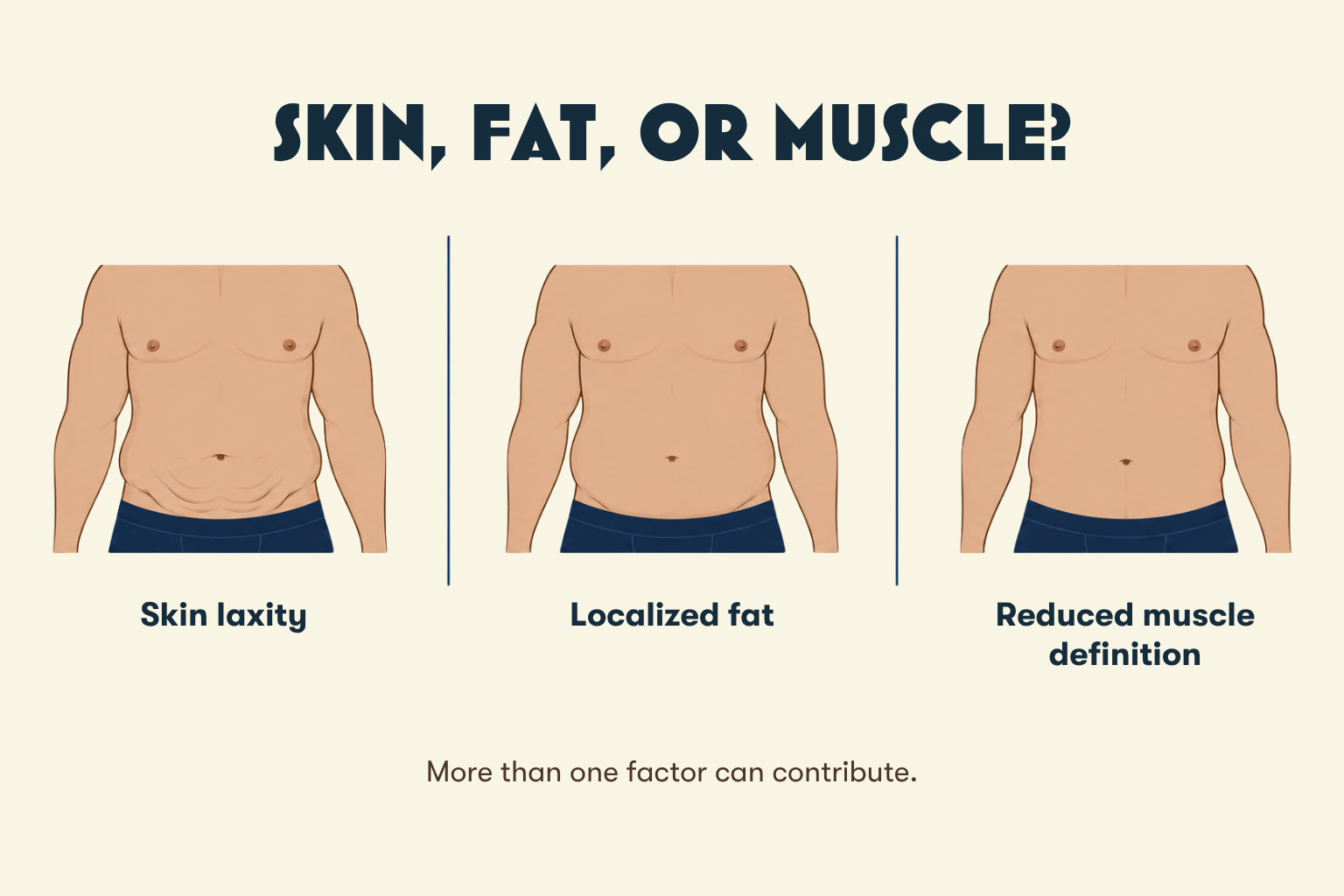
1. Skin laxity: The skin itself has lost firmness
Healthy skin stretches and returns toward its original shape thanks partly to collagen and elastin. Over time, aging, sun exposure, genetics and significant changes in weight can reduce that ability. The result may be sagging around the jawline, crepey skin on the neck, or loose tissue along the abdomen and arms.
Treatments that stimulate tissue remodeling and improve skin firmness are addressing this problem.
2. Localized fat: There's extra volume beneath the skin
Sometimes the skin isn't particularly loose. There's simply more fat beneath it than you'd like. A double chin, love handles or a persistent abdominal bulge may fall into this category.
Treatments designed to reduce fat can improve the contour of these areas. But removing fat doesn't necessarily tighten the skin covering it. In someone with poor skin elasticity, reducing the underlying volume may even make existing laxity more noticeable.
3. Muscle definition: The underlying shape isn't as pronounced
A man's abdomen can look soft despite relatively little body fat if his abdominal muscles lack development or definition. Exercise and resistance training remain fundamental ways to develop muscle. Certain body-contouring devices can also stimulate muscle contractions, although they are not substitutes for exercise or overall fitness.
4. Structural changes: The underlying support has changed
This is particularly relevant to the aging face. Facial fat compartments, bone structure, ligaments and soft tissues change over time. Cheeks may lose fullness, jowls may become more pronounced, and the transition between the jaw and neck may become less distinct.
Skin tightening can sometimes improve the appearance of these changes, but it cannot restore lost bone or reliably replace missing facial volume.
The takeaway: A better contour doesn't always require skin tightening—and skin tightening alone won't always create a better contour.
How Much Loose Skin Do You Have?
Once you've identified the problem, the next question is how pronounced it is. There's no universal dividing line between mild, moderate and severe laxity, but the distinction matters.
Mild laxity might mean the skin along your jaw feels less firm, your neck has developed a slightly crepey appearance, or the skin on your abdomen doesn't rebound quite as well as it once did. This is often where non-invasive technologies make the most sense.
Moderate laxity may involve more visible sagging, early jowls or loose skin that's apparent even when you're standing normally. Non-surgical treatments may still help, but the improvement may be noticeable without being dramatic.
Significant laxity usually means substantial folds, hanging skin or pronounced tissue descent. At that point, stimulating collagen is unlikely to accomplish what removing or repositioning excess tissue can.
The American Academy of Dermatology describes generally modest lifting or tightening from non-invasive procedures, with results typically developing gradually. [1] That's encouraging for the right candidate. It's also a useful reality check.
1. Non-Invasive Energy-Based Skin Tightening: Radiofrequency and Ultrasound
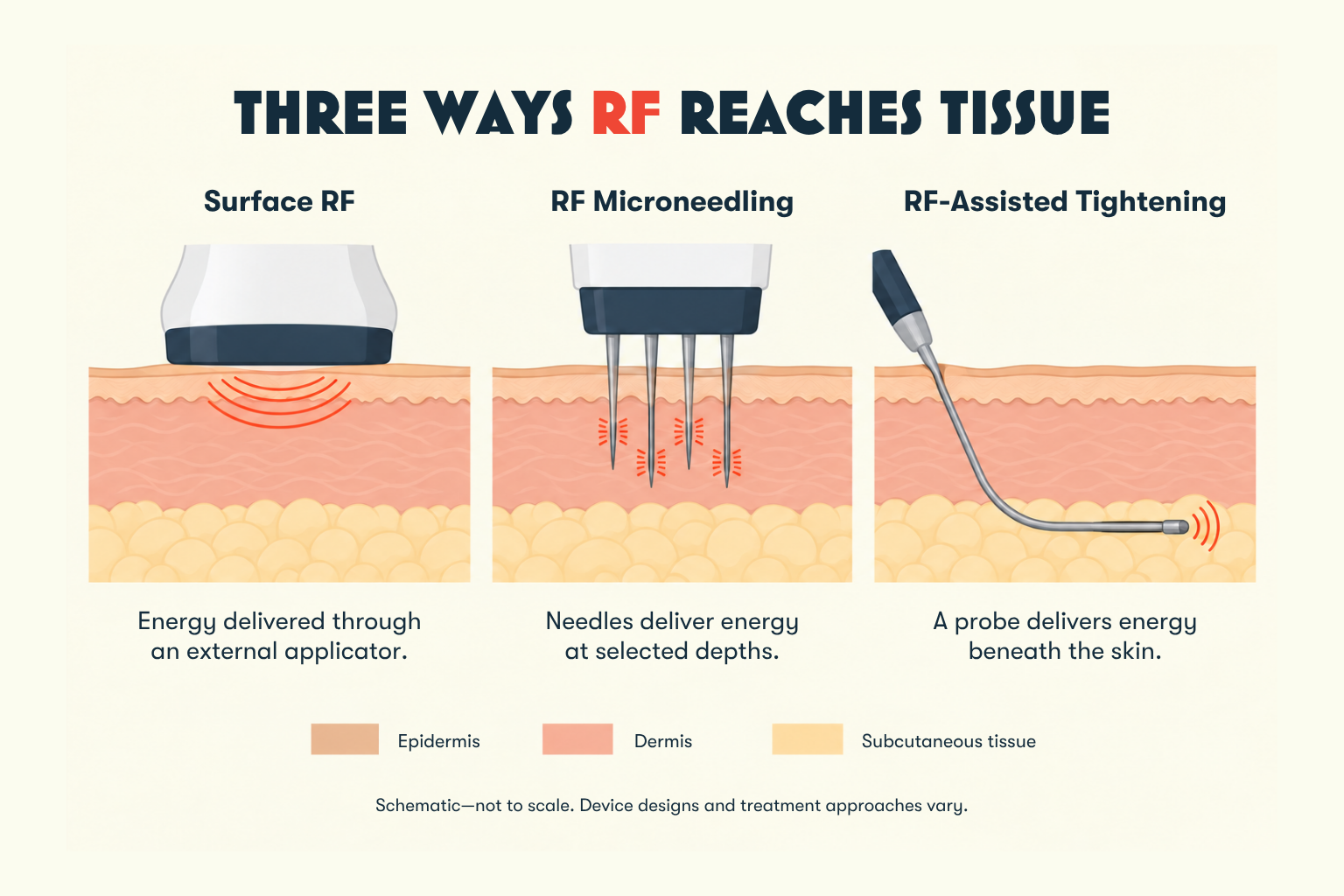
Two well-established categories of non-invasive skin tightening use radiofrequency (RF) or ultrasound energy. They work differently, but both aim to create controlled heating within tissue that encourages remodeling and can improve firmness over time. Neither requires needles or surgical incisions.
Radiofrequency skin tightening
Radiofrequency uses electrical energy to generate heat in targeted tissue. That controlled heating can cause changes in existing collagen and trigger a longer-term remodeling response. Over time, some patients experience improved firmness, elasticity and skin appearance.
Common RF technologies include Forma, a non-invasive RF treatment that delivers controlled heat; Define, a facial RF platform with applications for cheek and under-chin regions; and Thermage, a monopolar RF system used for skin tightening and rejuvenation.
These devices aren't interchangeable. They differ in electrode configurations, temperature control, treatment delivery and intended applications. A systematic review found that radiofrequency treatments could improve facial and neck skin laxity, elasticity and overall appearance, especially for patients seeking modest rejuvenation. [2]
Where RF makes sense: Men with early loss of skin firmness, mild jowling or selected areas of mild-to-moderate laxity who want gradual improvement without surgery.
Downtime: Typically little or none, although temporary redness, warmth, swelling or sensitivity can occur.
The limitation: Surface RF cannot remove substantial excess skin. Nor should every RF applicator be expected to reduce fat or produce the same degree of tightening.
Ultrasound skin tightening
Ultrasound devices use focused sound energy rather than electrical energy to heat tissue at selected depths. Two well-known examples are Ultherapy and Sofwave.
Ultherapy uses microfocused ultrasound, with imaging to help guide treatment. Sofwave uses a different ultrasound delivery system designed to heat the mid-dermis while protecting the skin surface through cooling. Both aim to stimulate tissue remodeling, but they're not technically identical.
These treatments are commonly considered for the face, neck and under-chin area. Certain systems also have applications for additional body areas, depending on the device. Results generally develop over time rather than appearing immediately.
Where ultrasound makes sense: Selected men with mild-to-moderate laxity who want non-invasive tightening and are comfortable with gradual, generally modest improvement.
Downtime: Usually limited. Temporary redness, swelling, tenderness or sensitivity can occur, and treatment can be uncomfortable despite minimal visible recovery.
The limitation: Ultrasound doesn't physically remove excess skin or reliably correct substantial sagging.
Which works better: RF or ultrasound?
There's no convincing reason to declare one technology family the winner for every patient. Both have evidence supporting improvement in appropriate cases, and their treatment goals overlap considerably.
What matters more is the specific device, the area being treated, your anatomy, the severity of laxity and how the treatment is performed. Choose the technology that fits the problem—not the one with the most impressive marketing.
2. RF Microneedling: When Skin Quality and Tightening Both Matter
Radiofrequency microneedling deserves its own category because it is materially different from surface RF.
Instead of delivering energy exclusively from outside the skin, RF microneedling uses tiny needles that penetrate the skin and deliver radiofrequency energy at selected depths. The combination of controlled needle injury and thermal energy stimulates remodeling within the treated tissue.
Morpheus8, made by InMode, is one of the better-known examples. For men, RF microneedling may be especially relevant when skin laxity occurs alongside rough texture, fine lines or acne scarring.
Consider a man in his late 40s with early jowling and skin that's become noticeably rougher over the years. He may want more than a general improvement in firmness. He may also want smoother, healthier-looking skin. RF microneedling may address both concerns within one treatment plan.
Because needles enter the skin and heat is delivered beneath the surface, the treatment is more intensive than non-invasive RF. Topical numbing is commonly used, and redness, swelling, sensitivity or temporary pinpoint marks can follow. More serious complications are possible, making appropriate patient selection and trained providers important. [3]
Where RF microneedling makes sense: Men with suitable degrees of laxity who also want to improve skin texture, wrinkles or scarring.
Downtime: Often several days of visible or noticeable recovery, depending on treatment intensity and individual response.
The limitation: Morpheus8 isn't surgery. Even when it improves skin firmness and quality, it won't remove significant hanging skin or reproduce a surgical lift.
3. Minimally Invasive RF Tightening: FaceTite, BodyTite and RF-Assisted Lipolysis
There's another category of radiofrequency treatment that goes considerably further beneath the skin.
Technologies such as FaceTite and BodyTite use an RF-emitting probe placed under the skin. They are frequently discussed under the term radiofrequency-assisted lipolysis, or RFAL.
Unlike surface RF or RF microneedling, these are procedures involving an incision or entry point and an instrument placed within the tissue. The goal may include tissue contraction, contour improvement and treatment of localized fat. Some procedures combine RF energy with liposuction to physically remove fat.
Heating tissue with radiofrequency and removing fat through liposuction are not the same thing.
Where might these treatments make sense?
Consider a man with more pronounced laxity beneath his chin and a stubborn pocket of submental fat. Non-invasive tightening may produce too little change to meet his goals, but his anatomy may not require a full neck lift. A minimally invasive approach may be worth discussing with a qualified physician or surgeon.
The same reasoning can apply to selected abdominal or body-contouring concerns. However, these procedures aren't simply stronger versions of a comfortable surface RF session. They involve more substantial procedural risks and recovery.
Anesthesia: Local anesthesia, sometimes with additional medication or sedation depending on the procedure.
Downtime: Typically measured in days to weeks rather than hours. Bruising, swelling, tenderness and temporary compression garments may be part of recovery.
Limitations: Results depend on the individual, the procedure and whether fat removal is included. Burns, contour irregularities and other complications are possible.
For someone who wants a meaningful change but isn't ready for skin-removal surgery, this category can occupy an important middle ground. Flycatcher does not currently offer FaceTite or BodyTite. We include them because understanding the full range of options is more useful than pretending every man should choose a completely non-invasive treatment.
4. What If You Need Fat Reduction or Muscle Definition Instead?
Here's where the terminology gets particularly confusing. A treatment can make the body look firmer or more defined without primarily tightening the skin. That doesn't make it ineffective. It means it's doing a different job.
Fat freezing: Cryolipolysis
Cryolipolysis, commonly associated with CoolSculpting, uses controlled cooling to target localized subcutaneous fat. The goal is to reduce visible fat bulges—not to stimulate muscle growth or remove loose skin.
Common treatment concerns include areas such as the abdomen, flanks and thighs, although eligible treatment sites depend on the particular device.
For a man close to his desired weight who still has a stubborn pocket of fat around his waist, this may be a more relevant category than skin tightening. But if that same man has skin that already hangs over his belt, reducing fat may not solve the problem.
Fat freezing also carries risks, including the uncommon but serious possibility of paradoxical adipose hyperplasia, where treated fat enlarges rather than shrinking. [4]
Muscle-focused technologies: Emsculpt NEO
Emsculpt NEO combines high-intensity electromagnetic muscle stimulation with radiofrequency heating. Its goal is different from that of conventional skin-tightening technologies: it is primarily used for improving muscle tone and body contour, with a fat-reduction component.
For men interested in abdominal definition, that distinction matters. If the underlying issue is weak or poorly developed abdominal musculature, stimulating muscle contractions may improve the appearance of the area in an appropriate candidate.
But it will not remove a substantial fold of loose skin. Nor should it be mistaken for a weight-loss treatment or a replacement for resistance training.
Why contouring and tightening get confused
Imagine two men who both end up with a more defined waistline. One has lost localized fat. The other has improved muscle definition. Both may look tighter in their clothes or in photographs, even though neither necessarily experienced a meaningful reduction in skin laxity.
The FDA distinguishes body-contouring technologies by their effects on fat, muscle and other tissues, and cautions that these procedures have limitations and risks. [4]
Better contour and tighter skin may look similar. They aren't necessarily the same biological result.
Where Does Skin Tightening Make Sense on the Body?
The same technology can be appropriate for one area and a poor choice for another. Here's how the treatment-selection problem changes depending on where you notice it.
Jawline and lower face
A softer jawline may involve early jowling, lax skin, volume changes or fullness beneath the chin. Non-invasive RF or ultrasound may make sense for early laxity. RF microneedling may be considered when skin texture also needs attention. But pronounced jowls and significant facial tissue descent may require surgical lifting for a substantial result.
Neck and under the chin
A double chin isn't automatically a skin-tightening problem. Excess submental fat, loose skin, platysmal muscle bands and structural anatomy can all influence the appearance of the neck. A man with mostly fat beneath his chin needs a different conversation from someone with substantial hanging skin.
For a deeper look, read our guide to treating loose neck skin and turkey neck.
Abdomen and flanks
A soft stomach may reflect localized fat, skin laxity, muscle definition or an underlying abdominal-wall issue. Men who have lost significant weight may also have both residual fat and excess skin. Fat-reduction and muscle-focused technologies can improve selected contour concerns, while skin-tightening treatments address laxity more directly.
But when the issue is a prominent fold of skin, energy-based treatment is unlikely to deliver the kind of change that surgery can.
Upper arms
Loose skin along the upper arms may become more noticeable with age or weight loss. Selected non-invasive treatments may improve mild laxity, but a substantial hanging fold is a different matter. For significant excess skin, an arm lift is the procedure designed to remove it.
Chest
The male chest deserves particular care because several different conditions can create a similar appearance. Chest fullness may involve fat, glandular breast tissue associated with gynecomastia, skin laxity or a combination. These require different evaluations and potentially different treatments.
A man with persistent breast enlargement should not assume a generic body-contouring or skin-tightening device is the answer. A medical evaluation is particularly important for new, one-sided, painful or otherwise unusual breast changes.
Thighs
Lax skin on the inner thighs can develop after significant weight loss or with aging. Mild laxity may be amenable to selected energy-based treatments, while persistent localized fat is a separate concern. For substantial skin folds, a thigh lift may be the more relevant procedure.
What Non-Surgical Skin Tightening Cannot Do
Here's the section that rarely makes it into the glossy treatment brochures. Non-surgical skin tightening can improve appropriate cases. But it has meaningful limitations.
It cannot physically remove excess skin. If a man has a large fold of skin hanging from his abdomen after significant weight loss, a device that stimulates collagen won't eliminate that fold.
It cannot reliably reverse advanced jowling or major neck laxity. Some improvement may be possible, but surface treatments can't duplicate surgical tissue repositioning.
It cannot fix every contour problem. Skin tightening won't eliminate a large fat deposit, build substantial muscle or replace significant facial volume loss.
It cannot guarantee dramatic changes. Results depend on anatomy, severity, device, treatment technique and individual tissue response.
And it doesn't make sense to think of every non-surgical procedure as a facelift without surgery. A facelift is a specific surgical procedure that repositions tissue and may remove excess skin. Energy-based tightening works through a different mechanism and produces a different degree of change.
That doesn't make non-surgical treatment inferior. It makes it appropriate for a different set of goals. A subtle improvement with very little downtime may be exactly what one man wants. Another man may prefer surgery because he wants a more substantial change and is willing to accept the recovery. Neither decision is automatically better.
5. When Surgery Is the Better Option
There are times when surgery is the more appropriate starting point rather than a last resort. For substantial skin laxity, surgery offers something that non-surgical devices cannot: the ability to remove excess skin and reposition supporting tissue.
- Facelift: Addresses significant facial sagging, including jowls.
- Neck lift: Addresses loose neck tissue and, when appropriate, underlying muscle bands.
- Tummy tuck (abdominoplasty): Removes abdominal excess skin and may repair separated abdominal muscles.
- Body lift: Addresses extensive redundant tissue following major weight loss.
- Arm lift or thigh lift: Removes excess skin from the upper arms or thighs.
After significant weight loss, skin may no longer conform to the body's new shape. The American Society of Plastic Surgeons identifies surgical body contouring as an option for removing this excess tissue and improving contour. [5]
Surgery also has more substantial tradeoffs: anesthesia, scarring, greater recovery time and risks such as bleeding, infection, fluid accumulation, poor healing or blood clots. For the right patient, those tradeoffs may be worthwhile.
Surgery is sometimes the only category capable of delivering the result a man actually wants.
Comparing Skin-Tightening and Body-Contouring Treatments
This comparison focuses on the underlying problem each treatment addresses, not on which machine is newest or most expensive.
| Category | Examples | Primary target | Needles/incisions? | Fat reduction? | Muscle effect? | Tightening? | Typical downtime | Intensity |
|---|---|---|---|---|---|---|---|---|
| Non-invasive RF | Forma, Define, Thermage | Mild–moderate laxity | No | Not primary; device-specific | No muscle-building effect | Yes, generally modest | Little or none | Low |
| Ultrasound | Ultherapy, Sofwave | Mild–moderate laxity | No | Not primary | No | Yes, generally modest | Little or none | Low |
| RF microneedling | Morpheus8 | Skin quality and laxity | Needles | Not a general fat-reduction treatment | No | Yes | Often several days | Moderate |
| RF-assisted tightening | FaceTite, BodyTite | Laxity, sometimes localized fat | Yes | May accompany liposuction | No | Yes | Days to weeks | High |
| Cryolipolysis | CoolSculpting | Localized fat | No | Yes | No | Not primary | Usually limited | Low–moderate |
| Muscle stimulation | Emsculpt NEO | Muscle tone and contour | No | Device-specific effect | Yes | Not primary | Little or none | Low–moderate |
| Surgery | Facelift, neck lift, tummy tuck, body lift | Significant excess skin/tissue | Yes | Sometimes | Some procedures repair/reposition muscle | Yes, by removing/repositioning tissue | Weeks or longer | Highest |
Downtime and intensity are broad comparisons, not individual recovery predictions. Specific devices, treatment settings and procedures differ.
How Do You Choose the Right Skin-Tightening Treatment?
By now, one thing should be clear: the best treatment isn't necessarily the most powerful or the most expensive. The decision starts with what is causing the appearance you're trying to change.
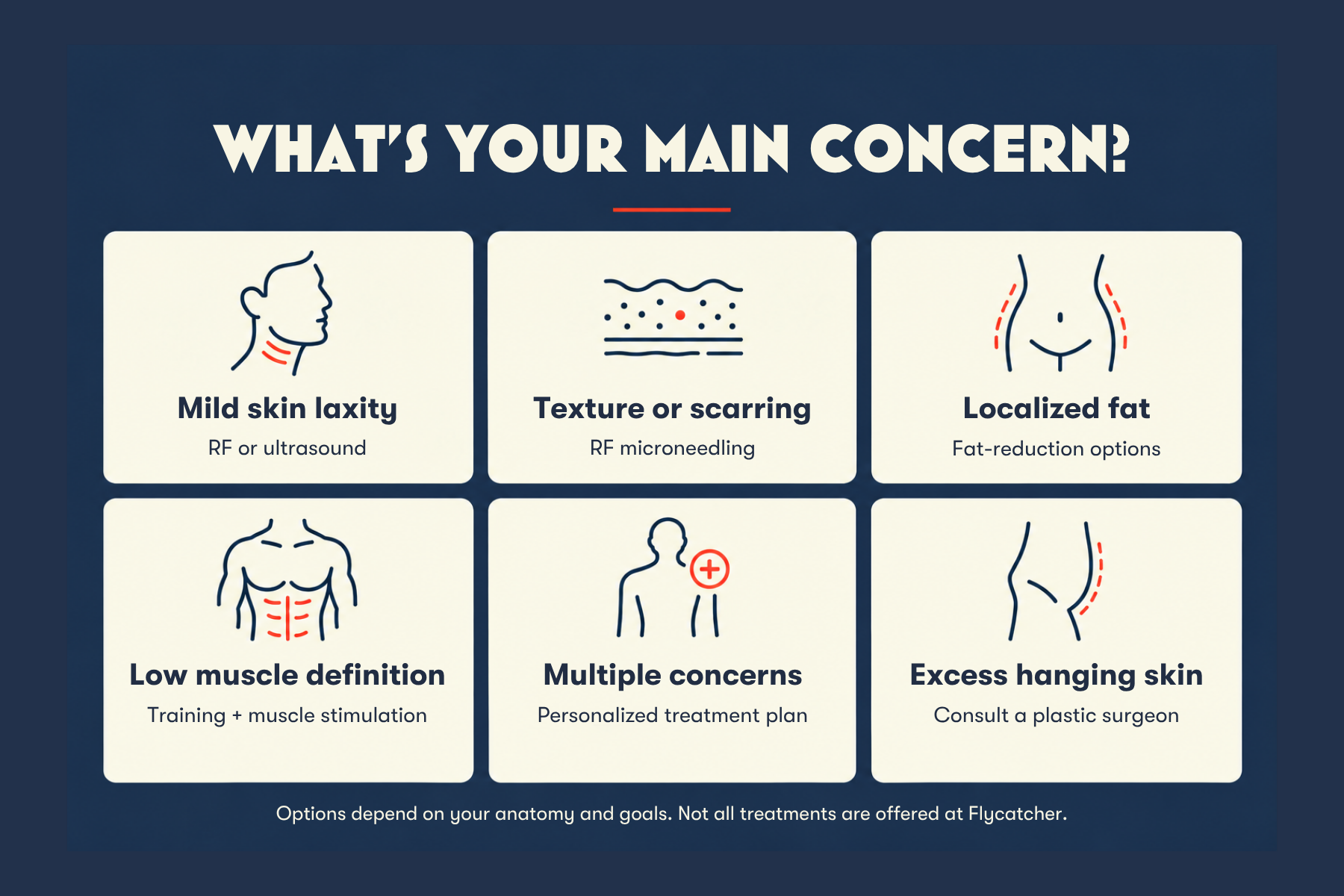
- If you have mild skin laxity and want minimal downtime, non-invasive RF or ultrasound may be a reasonable place to begin.
- If you have laxity along with texture changes, wrinkles or acne scarring, RF microneedling may deserve consideration.
- If you have more pronounced laxity combined with localized fat, minimally invasive approaches may be worth discussing with a qualified specialist.
- If you have stubborn fat but reasonably firm skin, fat reduction may be more relevant than tightening.
- If your main concern is abdominal muscle definition, training and selected muscle-focused technologies are a different conversation.
- If you have substantial hanging or redundant skin, a surgical consultation may save time, money and disappointment.
Your willingness to accept downtime matters, too. Some men would happily trade a few days of recovery for a stronger treatment. Others want improvements that fit around meetings, travel, workouts and everyday life. The right plan has to account for both the anatomy and the person.
Where Flycatcher's Skin-Tightening Treatments Fit
At Flycatcher, we focus on non-surgical treatments for men who want natural-looking improvements without unnecessarily aggressive procedures. Our current skin-tightening technologies include:
Forma: A standalone non-invasive radiofrequency treatment designed to deliver controlled heat to tissue. It may be appropriate for men seeking modest improvement in skin firmness with little downtime.
Define Chin and Define Cheek: Non-invasive facial RF applications focused on the under-chin, cheek and lower-face regions. These can be considered when improving the appearance of facial firmness and contour is the goal. See our Define/Evoke treatment guide for more detail on these applications.
Morpheus8: RF microneedling for men whose concerns may include skin laxity alongside texture, fine lines or scarring. It is a more intensive treatment than surface RF.
We do not offer every technology discussed in this guide, including Ultherapy, Sofwave, FaceTite, BodyTite, Emsculpt NEO or cryolipolysis. That's worth being clear about.
A useful consultation shouldn't begin with the assumption that a particular device is the answer. It should begin with a discussion of what is creating the problem and how much improvement is realistically possible. Sometimes that means recommending a non-surgical treatment. Sometimes it means acknowledging that another category—or a surgical consultation—may be more appropriate.
The Bottom Line: Treat the Problem, Not the Device Name
A sharper jawline, firmer abdomen or better-defined neck can mean very different things depending on the man. For one, the answer may be improving skin firmness. For another, it's reducing localized fat. For someone else, it's addressing muscle definition or substantial excess skin.
Modern non-surgical technologies can accomplish useful things. But understanding their limitations is just as important as knowing their benefits.
The right treatment depends less on which device is most popular and more on what is actually causing the problem: loose skin, fat, muscle, structural changes—or a combination.
If you're unsure what's contributing to your concern, Flycatcher can help. We offer one-on-one consultations for men in Austin, Bee Cave, Lakeway, Spicewood and the surrounding Texas Hill Country.
We'll help you understand what's causing the problem, which treatments may make sense, and how much improvement you can realistically expect—including when a different approach may be more appropriate.
Ready to get some answers? Schedule a consultation online or call or text us at (737) 239-0112.
References
- American Academy of Dermatology. Many Ways to Firm Sagging Skin.
- Austin GK, Struble SL, Quatela VC. Evaluating the Effectiveness and Safety of Radiofrequency for Face and Neck Rejuvenation: A Systematic Review. Lasers in Surgery and Medicine. 2022.
- U.S. Food and Drug Administration. Potential Risks with Certain Uses of Radiofrequency Microneedling. October 15, 2025.
- U.S. Food and Drug Administration. Non-Invasive Body Contouring Technologies.
- American Society of Plastic Surgeons. Body Contouring Following Major Weight Loss.
