


Most men looking into laser hair removal aren’t necessarily trying to become completely hairless.
Maybe you’re tired of asking someone else to shave your back. Maybe your neck is constantly irritated from a razor. Maybe you want less hair on your chest or shoulders. Or maybe there’s an area you’d simply prefer not to discuss at the dinner table.
Laser hair removal can dramatically reduce unwanted body and facial hair—and make grooming a lot easier. But it isn’t a magic eraser. You’ll need multiple treatments, some hair responds better than others, and “permanent” doesn’t necessarily mean every treated hair disappears forever.
Here’s what men should actually know before getting started.
Jump to: How it works · Permanence · Skin & hair color · Treatment areas · Sessions & pain · Safety · Preparation · Aftercare · Cost · At-home IPL
Laser Hair Removal for Men at a Glance
| Is laser hair removal permanent? | It can produce long-term, stable hair reduction. Some hair may be permanently removed, but regrowth and maintenance treatments are possible. |
| How many sessions do men usually need? | At Flycatcher, we generally plan for 6–8 treatments, although some men need more. |
| How far apart are treatments? | Usually 4–8 weeks, depending on the body area. Most areas are treated about every 6 weeks. |
| Does it hurt? | You’ll feel quick snaps or stings, but effective cooling can make treatment surprisingly comfortable. |
| Is there downtime? | Very little, although short-term aftercare restrictions matter. |
| What hair responds best? | Darker, pigmented hair generally responds best. Gray, white, very blond and red hair are more difficult to treat. |
| Can darker skin be treated? | Yes. The laser wavelength, treatment settings and provider experience matter. |
How Does Laser Hair Removal Work?
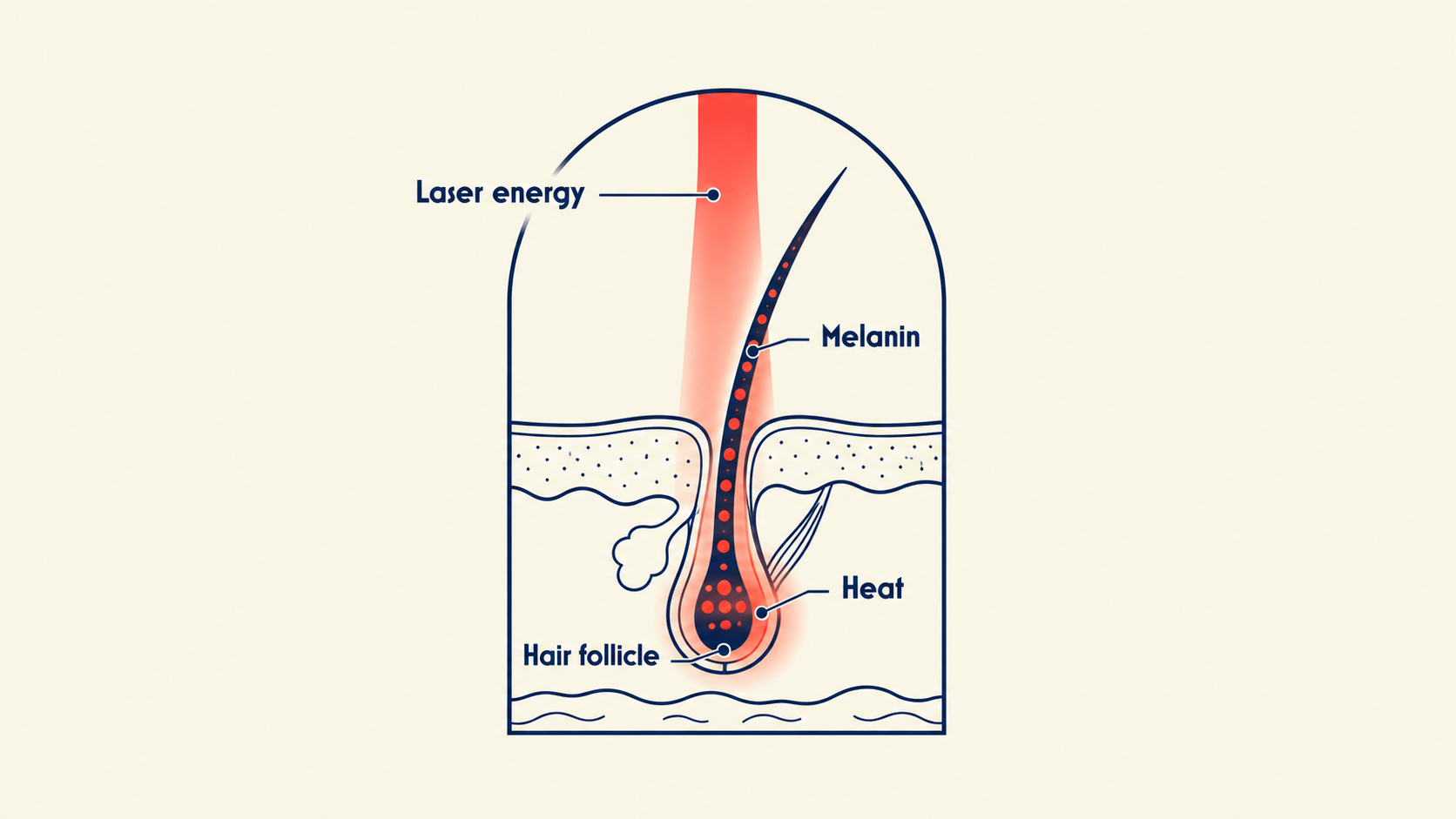
Laser hair removal uses concentrated light to target melanin—the pigment inside the hair. The light is converted into heat, which damages structures within the follicle responsible for producing hair and reduces its ability to grow again. [1]
The important word is pigment. The laser needs something to target, which is why darker hair generally responds better than very light hair.
There’s another reason you need more than one appointment: your hairs aren’t all growing at the same time.
Each follicle moves through its own growth cycle. Laser treatment is most effective when hair is actively growing, but only a portion of the follicles in an area are in that stage during any one appointment. Subsequent treatments catch additional follicles as they cycle into active growth.
That’s why laser hair removal is a process rather than a one-and-done procedure.
And there’s a lot of room between “hairy” and “hairless.” Some men want an area cleared as completely as possible. Others simply want to reduce density or create cleaner boundaries around a beard, neck or chest.
Hair reduction can be the goal. You don’t necessarily have to remove everything.
Is Laser Hair Removal Permanent—and How Long Do Results Last?
This is probably the most misunderstood part of laser hair removal.
The more accurate medical term is permanent hair reduction. FDA-cleared documentation for the GentleMAX family defines it as a long-term, stable reduction in the number of hairs that regrow after a treatment series. [2]
“Permanent hair reduction is defined as long-term stable reduction in the number of hairs regrowing after a treatment regime.”
— U.S. Food and Drug Administration
That does not mean laser hair removal only works temporarily. Some successfully treated follicles may stop producing hair permanently. But hair can also regrow over time, and follow-up treatments may be needed. When hair does return after a successful treatment series, it is often finer and lighter than before. [1]
Hormones are one reason maintenance may be necessary. A man taking testosterone replacement therapy, for example, may continue developing new or thicker body hair even after existing follicles have been successfully treated.
Additional Reading: On TRT and Growing More Body Hair? What Laser Hair Removal Can Do
The better question isn’t necessarily, Will I never see another hair again?
It’s: How much less hair will I have to deal with after completing treatment?
Does Skin Tone or Hair Color Affect Laser Hair Removal?
Yes. Laser hair removal works by targeting pigment in the hair, so both skin tone and hair color affect how treatment is planned.
Traditionally, dark coarse hair against lighter skin provided the easiest target. Modern professional laser systems can treat a much broader range of skin tones, but wavelength selection and treatment settings matter.
At Flycatcher, we use the Candela GentleMax Pro, which combines a 755 nm Alexandrite laser and a 1064 nm Nd:YAG laser. That gives our providers flexibility to select treatment parameters for different skin types. Candela identifies the 755 nm wavelength as optimal for lighter skin types and the 1064 nm wavelength as optimal for darker skin types. [3]
Research involving Fitzpatrick skin types III–VI also supports effective professional laser hair reduction in skin of color while reinforcing the importance of choosing appropriate technology and settings. [4]
Hair color remains a bigger limitation. Black and brown hairs usually contain enough pigment to provide a strong target. Gray and white hair contain very little melanin and generally respond poorly. Very blond hair can also be difficult, and red hair tends to respond less effectively because its pigment does not absorb laser energy as well. [1]
Modern technology has expanded who can be treated based on skin tone. It cannot completely overcome a lack of pigment in the hair itself.
Additional Reading: Laser Hair Removal for Dark Skin Tones: What to Consider
What Body Areas Do Men Commonly Treat?
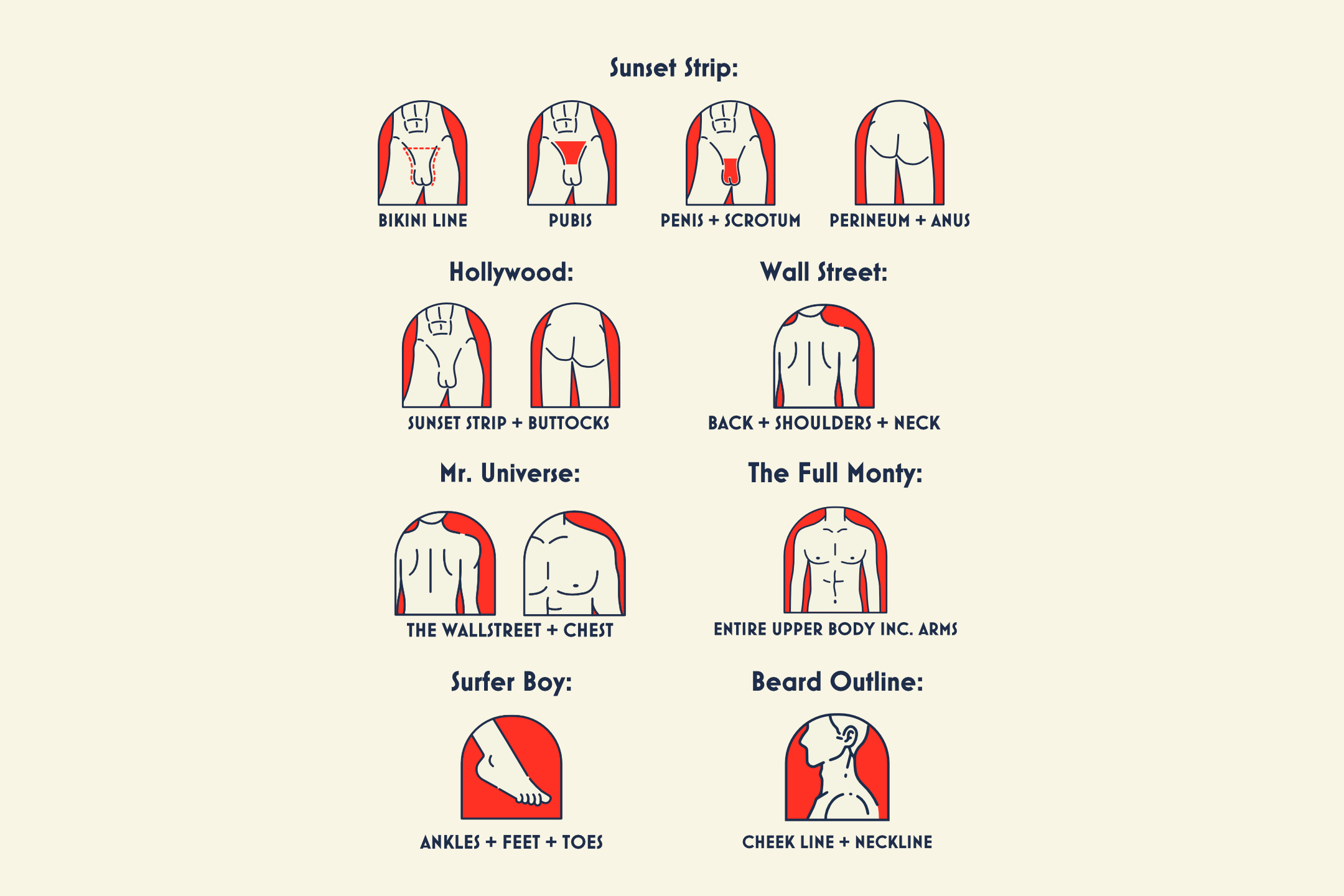
At Flycatcher, we treat unwanted hair pretty much everywhere men have it. And the reasons men come in are often more practical than simply wanting to look completely hairless.
Back and shoulders are big ones. They’re hard to reach, difficult to shave evenly and often require help from a spouse or partner. Some men want them completely clear. Others just want considerably less hair. We go deeper on the practical options in our guide to back hair removal for men.
Chest and abdomen are also popular. Plenty of men still want chest hair—they just don’t want quite so much of it. Reducing density can create a cleaner look without making someone appear completely hairless.
Face and neck treatments can clean up the beard line, remove unwanted cheek hair or reduce the amount of shaving needed around problem areas. Our guide to facial laser hair removal for men covers those goals in more detail.
Then there are men’s privates. Flycatcher regularly treats the pubic area, penis, scrotum, perineum, buttocks and between the cheeks. It may feel like an unusual conversation the first time you have it. For a laser provider who works with men every day, it really isn’t.
Arms, underarms and legs are common as well—particularly among active men and athletes. Cyclists may prefer less leg or body hair as part of their grooming routine. Swimmers often prefer a smoother body. Bodybuilders may want greater muscle definition without body hair covering it. Runners and other active men sometimes want less hair in areas prone to friction, sweat or repeated grooming. We cover those considerations separately in our guide to laser hair removal for swimmers, cyclists and bodybuilders.
There isn’t one “men’s laser hair removal look.” You can clear an area, reduce its density or simply stop hair from growing where you don’t want it.
Additional Reading: Laser Hair Removal For Men’s Privates (Including My Personal Experience)
What Does a Laser Hair Removal Treatment Series Actually Look Like?
How Many Laser Hair Removal Sessions Will You Need?
There isn’t one magic number.
At Flycatcher, we generally tell men to expect 6–8 treatments to achieve substantial hair reduction. Some men need more depending on the body area, density and coarseness of the hair, hormonal influences and how much reduction they actually want.
A small amount of coarse hair on your neck is not the same treatment problem as a densely covered back and shoulders.
Treatment spacing matters, too. At Flycatcher, treatments are generally scheduled 4–8 weeks apart depending on the area:
- Face and neck: approximately every 4 weeks
- Most body areas—including the back, shoulders, chest, abdomen and privates: approximately every 6 weeks
- Arms and legs: approximately every 8 weeks
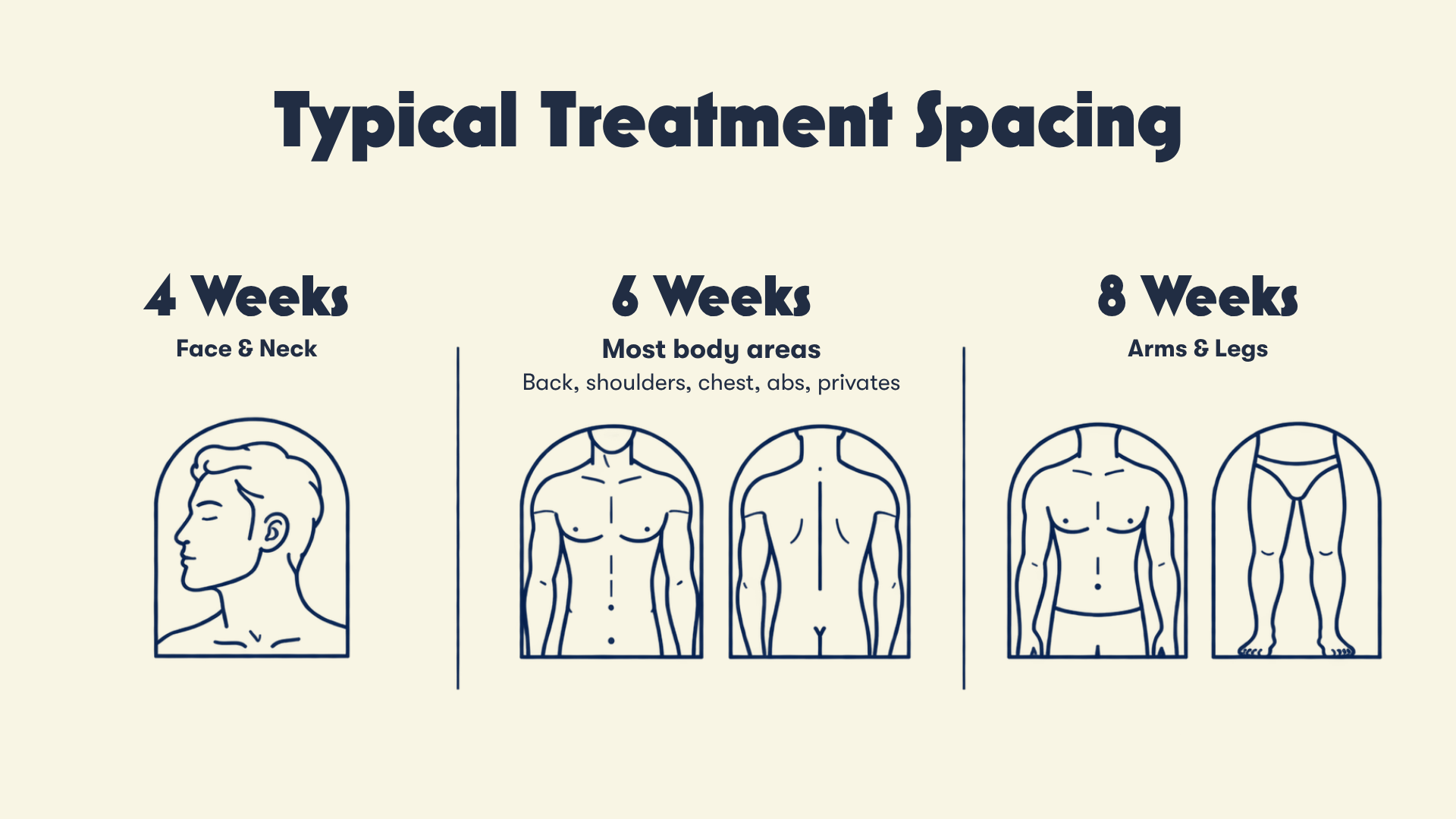
For most men treating body hair, six weeks is the interval they’ll encounter most often. That spacing gives additional follicles time to enter the active growth phase before the next treatment.
It also means laser hair removal is a commitment measured in months, not weeks.
Think of six treatments as a useful checkpoint, not a guarantee that every man will be finished on treatment number six.
Does Laser Hair Removal Hurt?
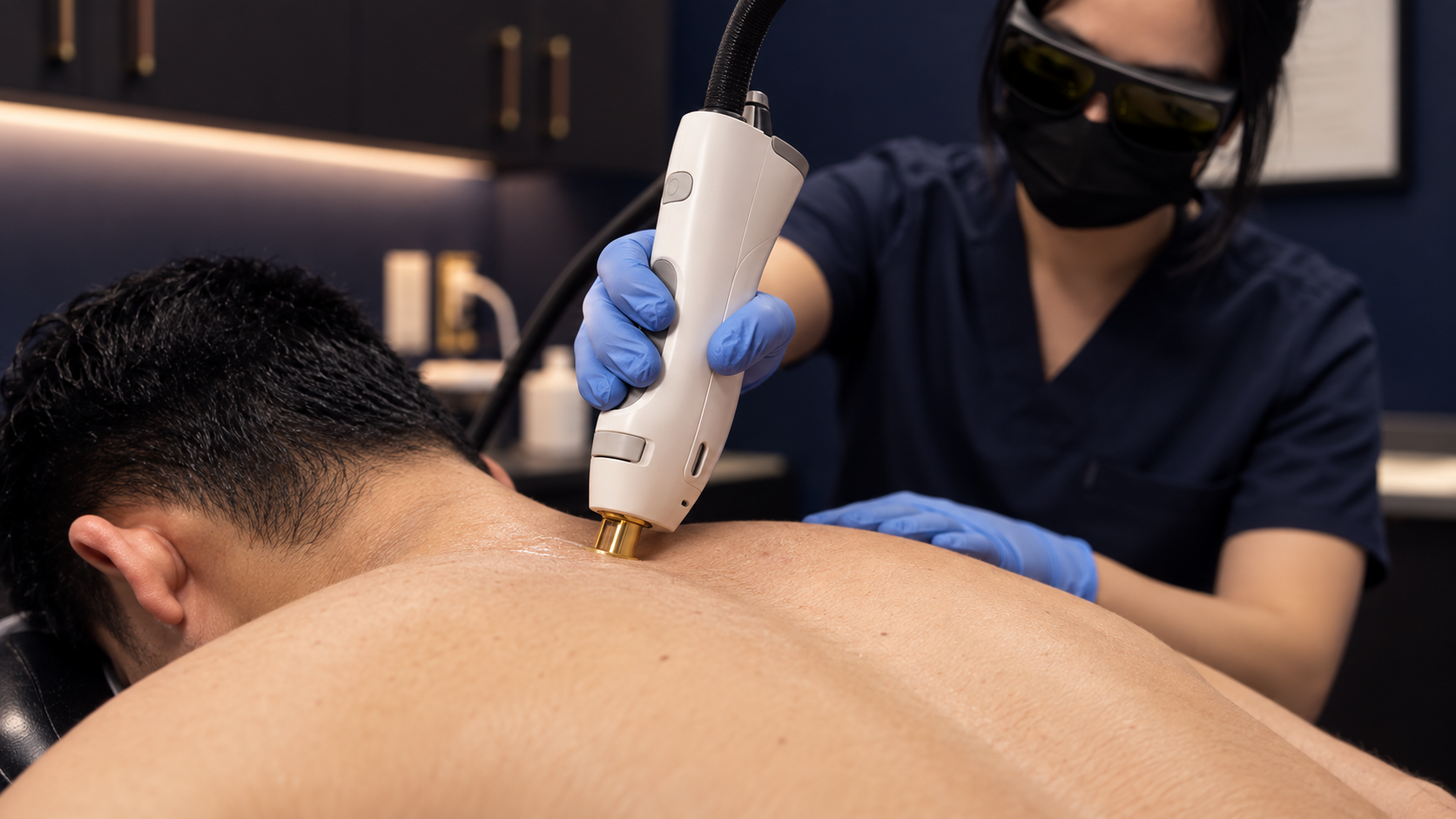
You’ll feel it, but most men tolerate it very well.
The sensation is usually described as a quick snap, sting or pinprick. How noticeable it feels depends on the area being treated, how dense and coarse the hair is and your individual sensitivity.
Some areas are simply more sensitive than others. Your back and your scrotum are not going to register exactly the same way.
One reason the experience at Flycatcher is particularly comfortable is the cooling technology built into our Candela GentleMax Pro. Its Dynamic Cooling Device sprays a precisely timed burst of cryogen coolant onto the skin immediately before each laser pulse, helping protect the surface of the skin and improve comfort. [3]
“The proprietary Dynamic Cooling Device delivers a precise cryogen burst milliseconds before each laser pulse, protecting the epidermis and maximizing patient comfort.”
— Candela Medical
Sessions are also relatively quick. A small area such as the neck may take only 10–15 minutes, while larger areas such as the back and shoulders naturally take longer.
So yes, laser hair removal can sting. With effective cooling and an experienced provider, it should be a very manageable experience for most men.
When Will You See Results?
Don’t expect to stand up after your first appointment and watch every treated hair fall onto the floor.
Treated hairs typically shed gradually over the following days and weeks. As you move through the series, you should start noticing less overall growth, slower regrowth, patchier regrowth and hairs that return finer than before. [1]
The important measure isn’t what the area looks like the morning after treatment. It’s how dramatically the amount of regrowing hair changes over the course of the series.
Is Laser Hair Removal Safe?
Laser hair removal is generally safe when the right device and treatment settings are used by a properly trained provider, but side effects are possible.
Temporary redness, warmth, swelling and changes in skin color can occur. Less-common complications include blistering, burns, crusting, scarring and changes in skin texture. Skin tone, tanning, sun exposure and treatment settings can all affect risk. [1]
This is one reason a provider should evaluate your skin tone and hair rather than treating every person with the same settings.
What About Tattoos?
Laser hair removal should not be performed directly over tattooed skin.
Hair-removal lasers are designed to target pigment. Tattoo ink creates another concentrated source of pigment that can absorb laser energy and increase the risk of burns or damage to the tattoo and surrounding skin. Tattooed skin is specifically excluded as a treatment area in current Mayo Clinic guidance. [1]
At Flycatcher, our laser providers identify and protect tattooed areas before treatment and maintain appropriate clearance around them.
How Should You Prepare for Laser Hair Removal?
Here’s the part that trips people up:
Shaving is good. Waxing, plucking and tweezing are not.
Shaving removes hair above the skin while leaving the follicle and pigmented hair below the surface available for the laser to target. Waxing or plucking pulls the hair out of the follicle—the exact target we need to leave in place.
Before treatment, avoid waxing, plucking or tweezing the area for the period recommended by your provider. Current medical guidance commonly recommends at least four weeks. [1]
At Flycatcher, clients are expected to arrive closely shaved before their appointment. Our laser providers do not shave treatment areas for clients.
Other preparation matters, too:
- Avoid tanning and excessive sun exposure before treatment.
- Avoid sunless tanning products.
- Protect exposed treatment areas with sunscreen.
- Arrive with clean skin.
- Tell your provider about medications, recent tanning, skin conditions, scarring tendencies and anything else that could affect treatment.
This isn’t busywork. Proper preparation helps your provider treat you more safely and effectively.
What Should You Do After Laser Hair Removal?
Laser hair removal usually doesn’t require traditional downtime. You can leave the appointment and get on with your day.
But freshly treated skin can be warm, red or mildly swollen, so you do need to treat it gently and protect it from significant sun exposure. [1]
At Flycatcher, our provider protocol includes:
- No swimming pools for 48 hours.
- No saunas or other high-heat environments for 48 hours.
- Avoid strenuous exercise or activity that causes significant sweating in the treated area for 48 hours.
- Continue protecting exposed treatment areas from the sun.
- Do not wax, tweeze or pluck between treatments.
Can You Shower After Laser Hair Removal?
Generally, yes. If the area feels irritated, keep the water comfortable rather than extremely hot and avoid aggressive scrubbing until the skin settles.
Can You Work Out After Laser Hair Removal?
Not immediately under Flycatcher’s protocol. Heavy exercise adds heat, sweat and friction to skin that may already be warm and irritated. Give it 48 hours.
That also means it makes sense to look at your calendar before booking. If you’re a cyclist planning a long Saturday ride, a swimmer who is in the pool every morning or you’re leaving tomorrow for a lake weekend, Thursday afternoon probably isn’t the ideal time for your laser appointment.
How Much Does Laser Hair Removal Cost for Men?
There isn’t one useful universal price because the areas men treat vary enormously.
A neckline takes far less time to treat than an entire back and shoulders. Someone treating one small area has a very different treatment plan from someone treating his chest, stomach, back and arms.
The overall cost usually depends on:
- Size of the treatment area
- Number of areas treated
- Number of treatments required
- Local market and provider
- Whether treatments are purchased individually, as a package or through a membership
The most useful question isn’t necessarily, “What is the cheapest price for one laser session?”
It’s: What will it cost to reach the amount of hair reduction I actually want?
That’s why pricing is better evaluated as a treatment plan rather than as a single advertised session.
Professional Laser Hair Removal vs. At-Home IPL
Search for laser hair removal online and you’ll see plenty of consumer devices promising similar results from your bathroom.
Many aren’t actually lasers.
Most consumer hair-reduction devices use intense pulsed light, or IPL, which delivers a range of light wavelengths rather than the focused wavelength produced by a laser.
Home IPL devices can reduce hair when used consistently, but they generally operate at substantially lower energy levels than professional systems and rely on repeated self-treatment and maintenance. A review of home-use laser and IPL devices found that these systems can produce meaningful hair reduction while also emphasizing that their fluence and treatment mechanisms differ from professional systems. [5]
The tradeoff is fairly straightforward.
At-home IPL can offer:
- Lower upfront cost
- Convenience
- Privacy
- A practical option for some small, accessible areas
Professional laser treatment offers:
- Professional equipment operating at higher treatment energies
- Settings selected for your skin and hair
- Multiple laser wavelengths when using a system such as the GentleMax Pro
- A trained provider treating the area evenly
- Far greater practicality for large or hard-to-reach areas
And that last point matters for men.
Using a home device on a small patch of your chest is one thing. Trying to systematically treat your entire hairy back every few weeks without being able to see or reach most of it is quite another.
For some men and some areas, home IPL can make sense. For others, professional laser hair removal is simply the more practical approach.
Is Laser Hair Removal Worth It for Men?
Laser hair removal tends to make the most sense when dealing with unwanted hair has become more annoying than treating it.
Maybe you’re tired of constantly shaving your neck or waxing your back. Maybe you have body hair you can’t easily groom yourself. Or maybe you simply want less of it and would rather not make hair removal part of your weekly routine.
It does require commitment: several treatments over a period of months and, for some men, occasional maintenance later.
But for the right candidate, the biggest payoff isn’t necessarily becoming hairless. It’s having much less hair to think about.
Considering Laser Hair Removal in Austin?
Flycatcher is a locally owned, independent medical aesthetics practice built specifically for men—not a national laser chain.
We created Flycatcher because men shouldn’t have to walk into an aesthetics practice and feel like the entire experience was designed for someone else. Our space is comfortable and discreet, the conversations are straightforward, and our providers work with men every day—including areas and concerns you may initially feel a little awkward talking about. To us, they’re simply part of the job.
Being independent also means the experience is personal. You’re working with a local team that gets to know you and what you actually want, rather than simply moving through a national chain’s standardized process.
Maybe you want your back completely clear. Maybe you just want less chest hair. Maybe you’re tired of shaving your neck. Or maybe you’re finally ready to deal with something a little farther south.
We’ll help you understand what’s realistic and build the treatment plan from there.
Learn more about Laser Hair Removal for Men at Flycatcher, including the areas we treat, current pricing and what to expect from your visit.
References
[1] Mayo Clinic. Laser hair removal. Updated July 21, 2026. Mayo Clinic.
[2] U.S. Food and Drug Administration. GentleMAX Family of Laser Systems — 510(k) Indications for Use. Definition of permanent hair reduction. FDA.
[3] Candela Medical. Gentle Pro Series. GentleMax Pro wavelengths and Dynamic Cooling Device. Candela Medical.
[4] Dorgham NA, Dorgham DA. Lasers for reduction of unwanted hair in skin of colour: a systematic review and meta-analysis. Journal of the European Academy of Dermatology and Venereology. 2020;34(5):948–955. PubMed.
[5] Town G, et al. Light-based home-use devices for hair removal: Why do they work and how effective they are? Lasers in Surgery and Medicine. 2019;51(6):481–490. PubMed.
