

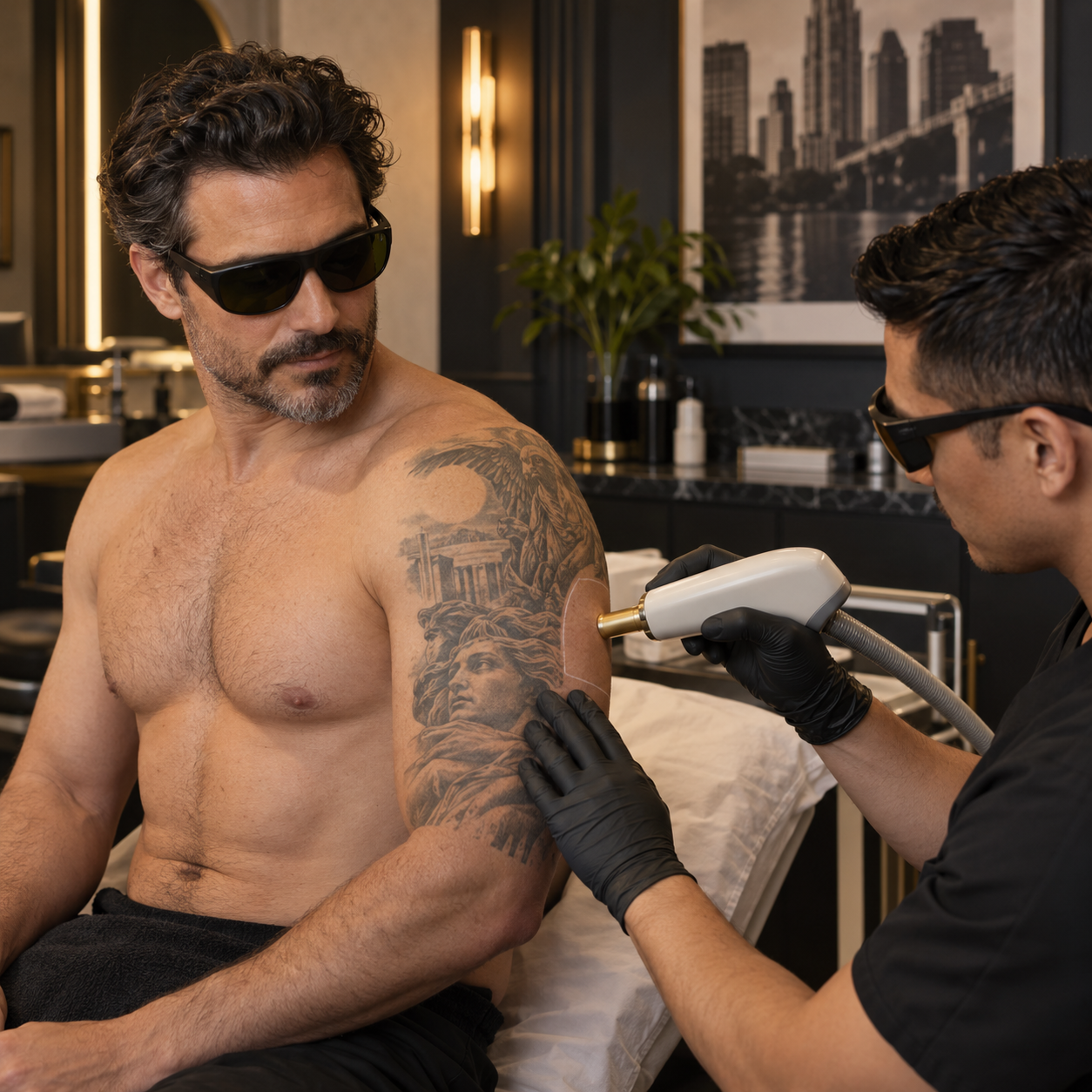
If you live in Austin, there’s a decent chance the body hair you want gone shares real estate with a tattoo.
A shoulder piece overlaps the upper back. A sleeve runs through the arms. Chest ink sits right where you’d like less chest hair. Or maybe you have a relatively small tattoo surrounded by an otherwise very treatable area.
So can you simply laser over it?
No. Laser hair removal should not be performed directly over tattooed skin. But having a tattoo doesn’t necessarily mean you can’t have laser hair removal in that area. In many cases, the surrounding skin can still be treated while the tattoo itself—and a safety margin around it—is avoided.[1][2]
The important part is planning for both safety and what the finished result will actually look like.
Why Can’t You Laser Directly Over a Tattoo?
Laser hair removal works because light energy is absorbed by pigment—primarily melanin in the hair. That light converts to heat, damaging structures in the hair follicle enough to reduce future growth.[1]
A tattoo introduces another concentrated source of pigment into the skin.
That tattoo pigment can also absorb laser energy. This can cause burns or blistering, changes in skin pigmentation, scarring, and unwanted fading or alteration of the tattoo itself.[2][3]
Different tattoo colors absorb different wavelengths differently, which is one reason tattoo-removal lasers and protocols vary depending on the pigment being treated.[4]
But that doesn’t give us a list of tattoo colors that are “safe” for laser hair removal.
The practical rule is simpler: don’t fire a hair-removal laser directly over tattoo pigment.
Can You Get Laser Hair Removal Around a Tattoo?
Yes, often.
The workaround is to treat the surrounding skin while deliberately avoiding the tattoo.
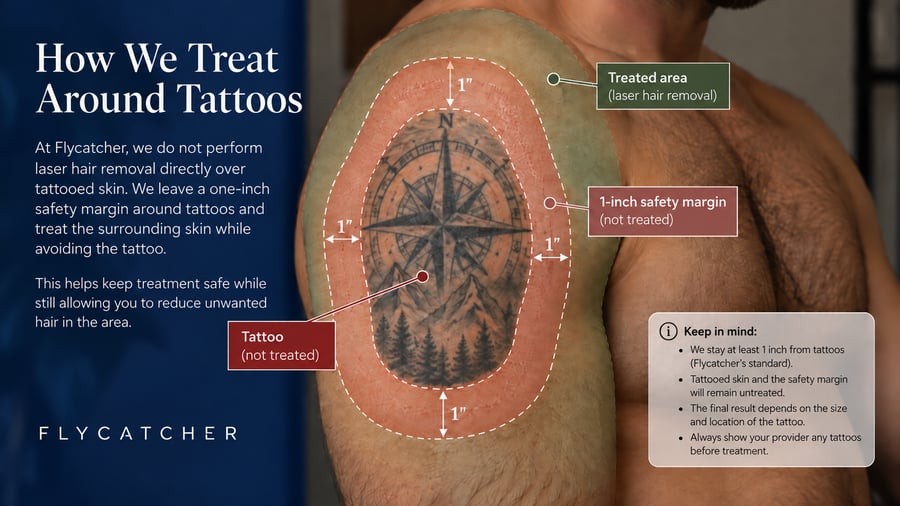
At Flycatcher, we stay at least one inch away from tattooed skin during laser hair removal. We identify the tattoo before treatment so there is a clear boundary the laser does not cross.
That one-inch margin is Flycatcher’s treatment standard. Other providers may use different protocols based on their equipment, training, and treatment procedures.
This is also why tattoos should be identified before treatment begins. If a tattoo sits near the edge of an area you want treated, that boundary needs to become part of the treatment plan.
The Bigger Question: What Will the Remaining Hair Look Like?
This is the part men don’t always think about beforehand.
The tattooed skin—and Flycatcher’s one-inch margin around it—will remain untreated. That means hair growing through and immediately around the tattoo can remain even as the surrounding hair becomes progressively thinner.
How noticeable that is depends largely on the size and location of the tattoo.
| Tattoo situation | What it may mean for laser hair removal |
|---|---|
| Small upper-arm tattoo | A relatively small patch of untreated hair may be easy to blend or groom manually. |
| Large shoulder piece | The tattoo may interrupt the transition between a treated back, shoulder, and upper arm. |
| Chest tattoo | Hair remaining through and around the tattoo may become more noticeable if the surrounding chest is heavily reduced. |
| Full or partial sleeve | A significant portion of the arm may need to remain untreated. |
| Large back tattoo | If the tattoo covers most of the desired area, laser hair removal may have limited value for that portion of the back. |
This connects to something we think is important with natural-looking laser hair removal for men:
Your body isn’t divided into neat treatment-menu squares.
Your back flows into your shoulders. Your shoulders flow into your arms. Your chest flows into your abdomen.
A tattoo creates another boundary.
If everything around that boundary is heavily reduced without thinking about the remaining hair, you can create a more obvious transition than you intended.
For a small tattoo on the arm, that may hardly matter.
For a sleeve, large chest piece, or substantial back tattoo—which isn’t exactly unusual around Austin—it can change the entire treatment plan.
Additional Reading: Back Hair Removal for Men: Laser Cost, Sessions & What to Expect
What if the Tattoo Is Old or Faded?
An old tattoo is still a tattoo.
Even if the ink has visibly faded over time, residual pigment remains in the skin. The same concern applies to a tattoo that has undergone only partial laser tattoo removal.
“Faded” does not automatically mean “safe to laser over.”
Tattoo removal works by breaking tattoo pigment into smaller particles that the body gradually clears. It generally takes multiple treatments, and complete removal isn’t always possible.[4]
If visible pigment remains, tell your laser hair removal provider rather than assuming the area is ready for treatment.
What if the Tattoo Is New?
A fresh tattoo is healing skin.
Redness, tenderness, flaking, and scabbing can all occur while the area recovers. Most tattoos take roughly two weeks to heal at the surface, although healing varies and deeper healing can continue beyond that point.[5]
That doesn’t mean day 15 is automatically a green light for laser hair removal.
Don’t perform laser hair removal on or immediately adjacent to skin that is still healing, inflamed, scabbed, irritated, or otherwise recovering from a new tattoo.
Let the tattoo heal first, then have the area evaluated before treatment.
What if You’re Planning Tattoo Removal Too?
Tattoo removal and laser hair removal use laser energy for very different purposes.
Tattoo-removal lasers are designed to target tattoo pigment so it can be broken apart and gradually cleared by the body. Laser hair removal is designed to target pigment associated with the hair follicle.[4]
If your eventual goal is to remove hair from the same skin currently covered by a tattoo, the tattoo-removal process would need to come first. Once removal is complete and the skin has fully healed, that area can be reassessed for laser hair removal.
But there’s an important qualification:
A partially removed tattoo shouldn’t automatically be treated as tattoo-free skin.
Residual pigment may still be present even after the tattoo looks substantially lighter. Tattoo-removal treatments also require healing time between sessions.[4]
If laser hair removal is being considered on separate, non-tattooed skin nearby while tattoo removal is underway, talk through both treatment areas with the provider first. Whether that makes sense depends on where the treatments are being performed and how the skin is healing.
There isn’t one universal waiting period that applies to every combination of tattoo removal and laser hair removal, so this is better handled through treatment planning than an arbitrary calendar rule.
Additional Reading: Tattoo Removal Near Bee Cave, Lakeway, and Spicewood: Cost, Reviews, and Local Options
Tattoos Don’t Necessarily Rule Out Laser Hair Removal
The simple answer is:
We don’t laser directly over tattoos. We can often laser around them.
But the tattoo becomes part of the treatment map.
If you have a small tattoo in the middle of a large treatment area, working around it may be straightforward.
If you have a sleeve, chest piece, shoulder piece, or large back tattoo, the more important question may be what the untreated hair will look like after everything around it has been reduced.
That’s a conversation worth having before the first session.
If you have tattoos in or near the area you want treated, show them to your provider so the plan can account for what can be treated, where the laser should stop, and how the final hair pattern is likely to look.
Flycatcher provides laser hair removal for men at our Austin-area studio at 18225 State Highway 71, Suite B200, about three miles west of the Hill Country Galleria. If you’d like help mapping out a tattooed treatment area, schedule a consultation or call/text us at 737-239-0112.
References
[1] Mayo Clinic. Laser Hair Removal. Explains the mechanism of laser hair removal and states that treatment should not be used on skin with tattoos.
[2] Town G, et al. Guidelines on the Safety of Light-Based Home-Use Hair Removal Devices from the European Society for Laser Dermatology. Journal of the European Academy of Dermatology and Venereology. 2012;26(7):799-811.
[3] Wolf R, Orion E, Marcos B, Matz H. “More is missed by not looking than by not knowing.” International Journal of Dermatology. 2006;45(1):50. Includes case reports of tattoo injury following Alexandrite laser hair removal.
[4] U.S. Food and Drug Administration. Tattoo Removal: Options and Results. Discusses wavelength-dependent tattoo pigment response, multiple-session treatment, and healing between tattoo-removal procedures.
[5] Mayo Clinic. Tattoos: Understand Risks and Precautions. Discusses tattoo healing, skin injury, and aftercare.
