


A lot of men considering laser hair removal aren't trying to become completely hairless.
They just want less hair.
Maybe shaving your back before every pool day is getting old. Maybe shoulder hair has started creeping farther down your upper arms. Maybe you like having chest hair—you'd just like a little less of it.
Or maybe you'd like to spend a day on Lake Travis or a staycation at the Austin Motel without first wondering whether you need to break out the body trimmer.
That creates a different laser hair removal question:
Can you reduce body hair without ending up looking unnaturally hairless?
Yes. But there is an important limitation to understand.
Laser hair removal can be planned around a desired direction: less hair, easier maintenance, cleaner transitions, or maximum reduction. What it can't do is precisely leave an exact percentage of your original hair behind.
Think of it as directional control rather than a density dial.
Laser Hair Removal Doesn't Have to Mean Removing Every Hair
The phrase laser hair removal makes the treatment sound more absolute than it really is.
The FDA uses the term permanent hair reduction to describe a long-term, stable decrease in the number of hairs that regrow after treatment. It does not mean every treated follicle is guaranteed to disappear forever. [1]
That's important if you don't actually want every hair gone.
You might want a much less hairy back while keeping some chest hair. You may want to clean up your shoulders without creating completely bare upper arms. Or you may want less hair around your stomach and privates without turning your entire torso into one smooth surface.
Laser doesn't have to be an all-or-nothing proposition.
Additional Reading: Everything Austin Men Need to Know About Laser Hair Removal
Can Laser Hair Removal Be Used Just to Thin Body Hair?
Yes—but “thinning” needs to be understood correctly.
Laser progressively reduces hair over a series of treatments. If you continue treating an area, you're generally pursuing greater reduction.
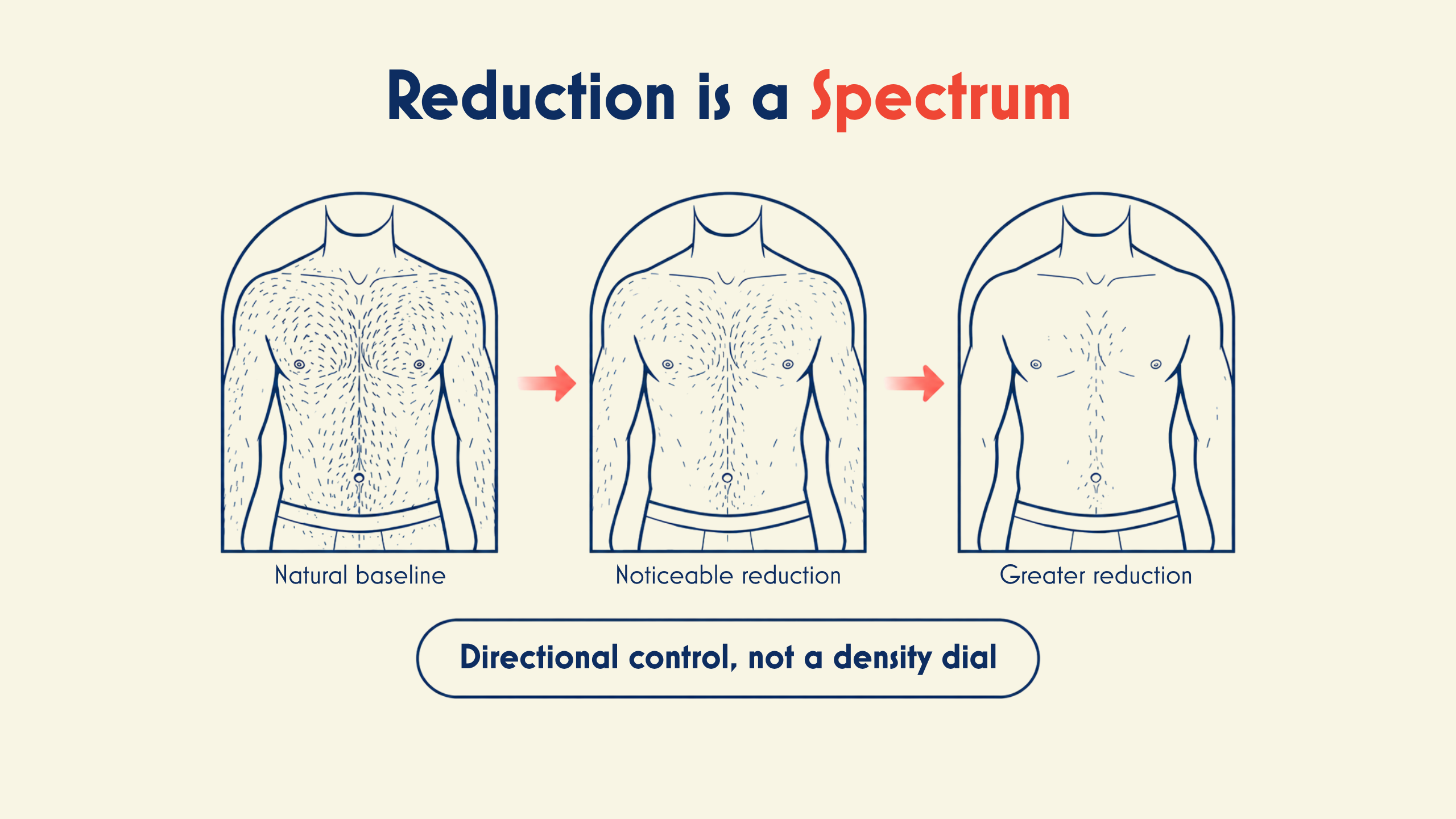
At Flycatcher, we don't assume every client should automatically keep going until we've removed as much hair as possible.
We look at how your hair is responding and compare that with the result you actually want. If you reach a point where you like the amount of hair that's left, that's a good time for us to reassess whether additional treatment makes sense.
What we can't do is precisely choose the percentage that remains.
You can't walk into a consultation and order:
“I'd like exactly 47% of my chest hair removed, please.”
Individual follicles don't all respond identically. Body area, skin and hair color, hair-growth stage, laser type, hormonal status and the treatment plan can all influence the result. [2]
So we can work toward less rather than none. What we can't promise is a mathematically exact final density.
Why Can Laser Hair Removal Look Patchy During Treatment?
This is where men who want reduction rather than complete removal sometimes get nervous.
You're two or three treatments into the process. One part of your chest looks considerably thinner. Another still has obvious growth. Your back suddenly looks uneven.
That doesn't necessarily mean something went wrong.
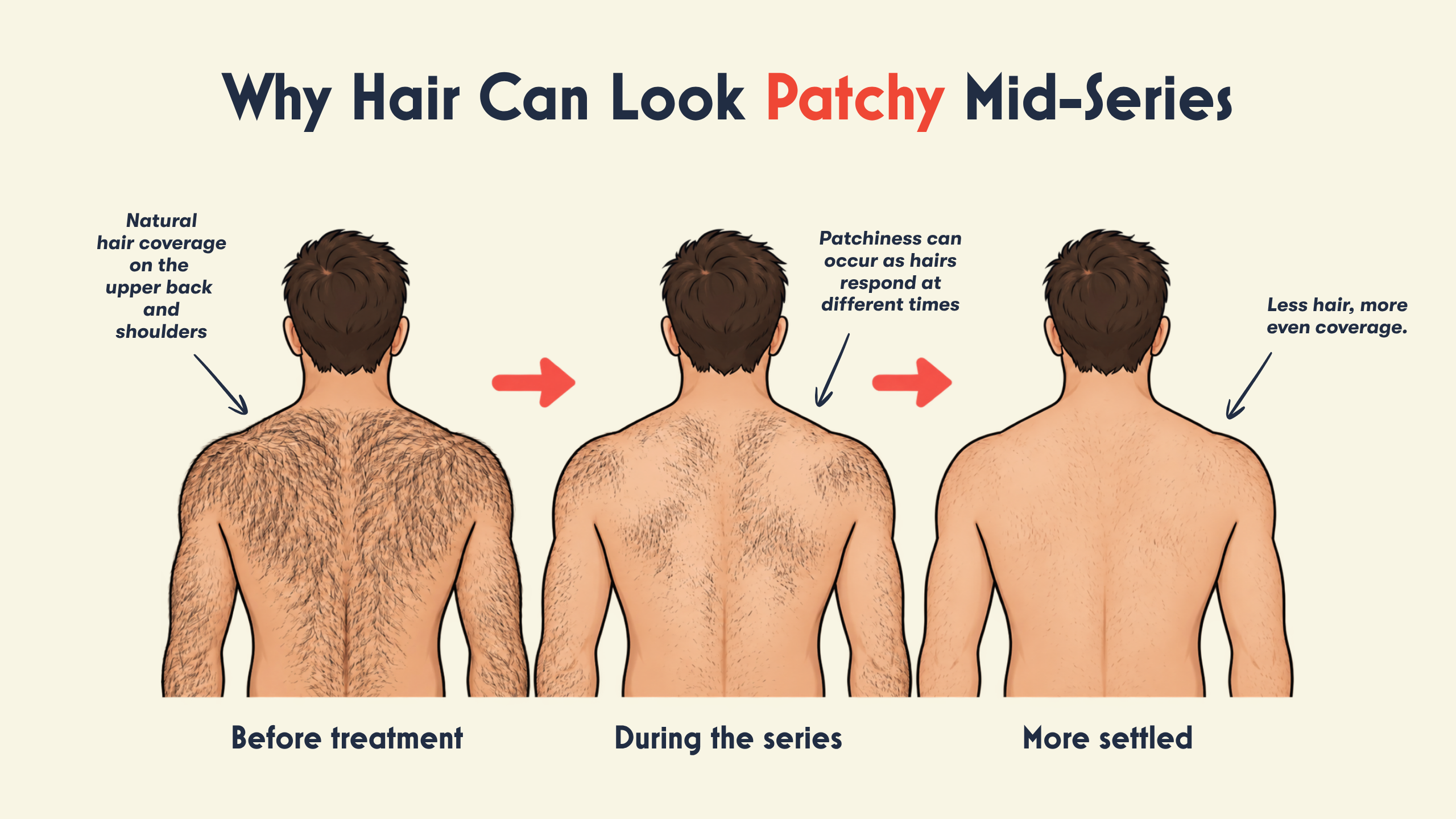
Hair grows in cycles. Laser works best on pigmented hairs that are actively growing, and all the follicles in an area aren't in the same growth stage at the same time. That's one reason multiple sessions are necessary. [2]
There's also a delay after treatment. Successfully treated hairs don't instantly vanish when you walk out the door. They generally shed over the following several days to weeks. [3]
During that process, some hairs may be disappearing while untreated or less-responsive hairs remain visible. That can make the remaining growth stand out more for a while.
So there are two very different things that can look “patchy.”
Temporary unevenness during a treatment series can simply be part of progressive hair reduction.
An unnatural final pattern, on the other hand, may come from an obvious stopping line, inconsistent treatment coverage, or a treated area that doesn't blend well with the hair around it.
Those aren't the same problem.
A Natural Result Is Often About the Transition
Men tend to think about laser hair removal the way a treatment menu is written:
Back. Shoulders. Upper arms. Chest. Stomach. Privates.
Your body isn't divided into treatment-menu squares.
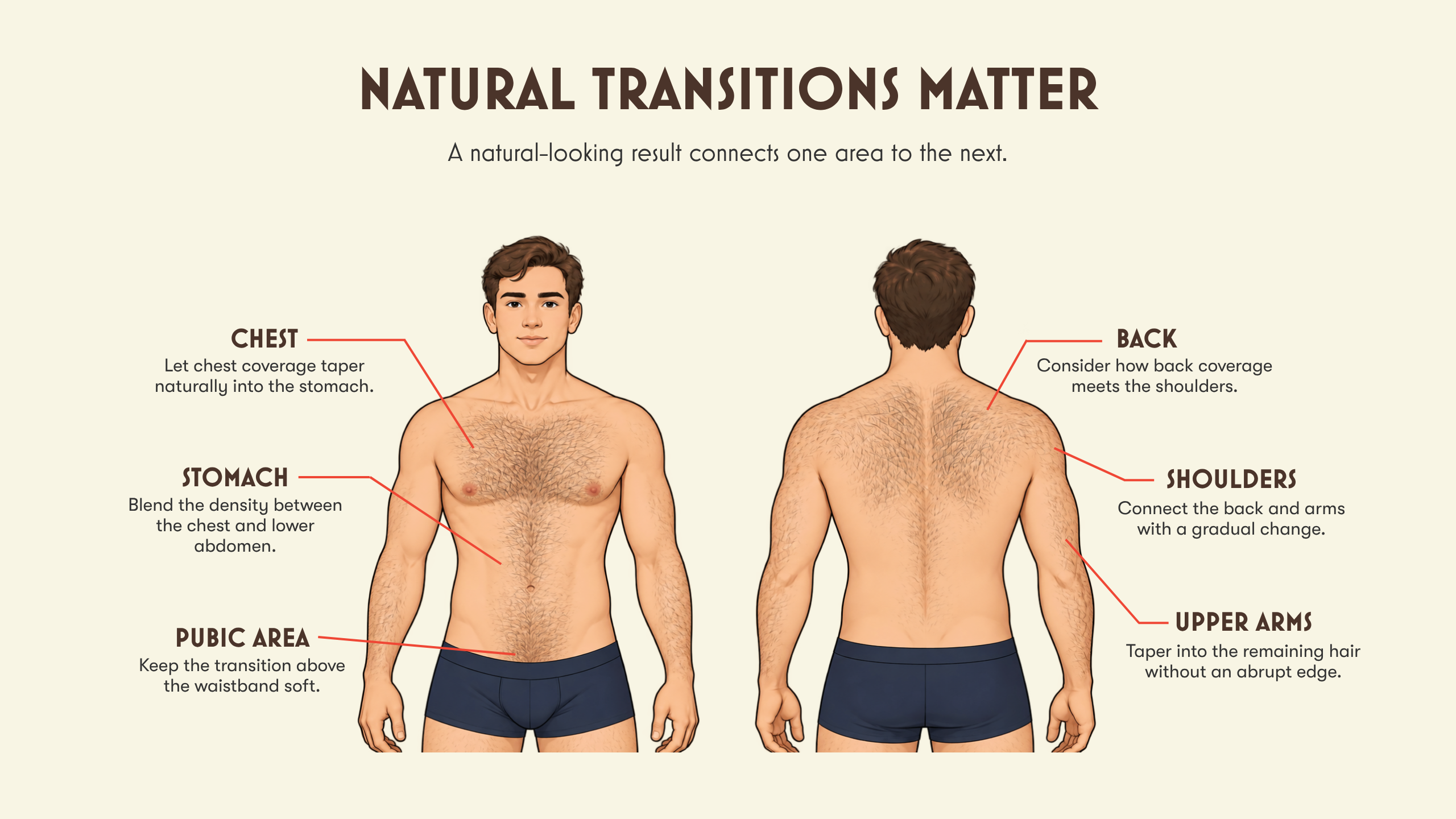
Your back flows into your shoulders. Your shoulders flow into your upper arms. Your chest continues into your stomach. Your abdominal hair eventually meets your pubic hair.
That means natural-looking laser hair removal is often as much about transitions as it is about the amount of hair removed.
Imagine aggressively reducing nearly all the hair on a man's back while leaving very dense shoulder and upper-arm hair untouched.
The problem isn't necessarily that his back is too smooth. It's that there may now be an obvious border between two very different amounts of hair.
That border can become fairly easy to notice when you're shirtless at Barton Springs.
This is why we prefer to look at the whole visual area, rather than simply the square inches being treated.
There isn't a universal medical formula that says every man's back treatment should end at exactly the same spot. Where treatment stops—and whether an adjacent area should also be reduced—depends on your natural hair pattern and what you want the finished result to look like.
Where Should Laser Hair Removal Stop on a Man?
There isn't one correct stopping line.
Back, Shoulders and Upper Arms
This is probably the clearest example.
Some men have dense hair covering the full back and shoulders that gradually tapers as it reaches the upper arms. Others have isolated patches on their shoulders. Some have significant hair extending well down the arms.
If we heavily reduce the back but leave everything immediately around it dense, the contrast can become noticeable.
That doesn't mean we need to remove all your arm hair.
Instead, we may want to consider whether the shoulder or upper-arm transition should also be reduced so that the remaining pattern looks natural.
Additional Reading: Back Hair Removal for Men: Laser Cost, Sessions & What to Expect
Chest and Stomach
Chest hair is different because plenty of men actually like having it.
Maybe you have a dense chest but would prefer it lighter. Maybe you like the chest exactly as it is but have much heavier growth across your stomach. Or maybe you'd simply like an Austin pool day to require less advance planning with the trimmer.
Your chest and stomach don't necessarily need to have identical hair density.
They just need to make sense together.
A completely bare stomach ending abruptly underneath a very hairy chest may look more obviously treated than a gradual transition that works with your natural pattern.
Stomach and Privates
The same thinking applies lower on the torso.
You may want significant reduction around your private areas without removing every visible hair from your abdomen downward.
Or you may prefer a cleaner transition between the stomach and pubic region.
There's no universally “natural” amount of pubic hair. Some men want almost none. Others want enough reduction to make grooming easier while still keeping some natural hair.
The important question is how the treated and untreated areas look together.
Additional Reading: Laser Hair Removal for Men's Privates
Why Provider Continuity Can Matter
When men hear consistency in laser hair removal, they often think about staying on schedule.
That's part of it. But consistency can also mean having a provider who gets to know your treatment history.
Over several sessions, our provider becomes familiar with your starting hair pattern, the areas we've already treated, how your skin and hair responded, your previous settings and—most importantly—the result you're trying to achieve.
That becomes particularly useful when your goal is more nuanced than “remove everything.”
Maybe your right shoulder responded faster than your left. Maybe you decided halfway through the series that you like a little more chest hair than you expected. Maybe we're intentionally trying to soften the transition between a reduced back and untreated arms.
Having that history can help us make thoughtful adjustments from one visit to the next.
That doesn't mean switching providers automatically leads to a poor result. Good records, photographs and communication can preserve treatment continuity too.
But when we're gradually working toward a specific aesthetic endpoint, having a provider who knows where we've been and where we're going can be valuable.
Can You Change Your Mind Partway Through?
Yes.
In fact, if your goal is reduction rather than maximum removal, reassessing your progress should be part of the process.
You may start treatment convinced that you want your back almost completely clear and realize after several sessions that you actually like the lighter amount of hair that's left.
The opposite can happen too. You may initially want modest thinning and then decide the easier grooming is worth continuing.
What you shouldn't assume is that stopping treatment will simply return everything to exactly where you started.
Laser can produce long-lasting hair reduction. Some hair may eventually regrow, and regrowth may be finer or lighter than before, but the amount and timing vary. Follow-up treatments may also be needed over time to maintain a particular level of reduction. [3]
So you can change the treatment plan.
You can't count on predictably reversing the reduction you've already achieved.
What If You Want More Body Hair When You're Older?
This is a legitimate question.
A man in his 40s may love the idea of eliminating virtually all his chest or back hair today. Will he want exactly the same thing at 60?
Maybe.
Maybe not.
Grooming preferences change. Styles change. Relationships change. And none of us knows exactly what our future selves will prefer.
That's not an argument against laser hair removal. It is an argument for being intentional before automatically pursuing maximum reduction.
There's another practical consideration: laser depends on pigment in the hair. Gray and white hairs have less pigment for the laser to target, which makes them harder to treat effectively. Very light blond and red hair also tends to respond less effectively. [3]
So if you're unsure whether you want to completely clear an area, there's no reason to treat zero hair as the required destination from day one.
Some men absolutely do want as little body hair as possible. If that's your goal, great.
The important thing is that it actually is your goal—not simply the assumption that laser hair removal always has to end there.

Planning Natural-Looking Laser Hair Removal at Flycatcher
At Flycatcher, the conversation starts with what you want the finished result to look like.
Which areas do you want reduced? Which hair do you want to leave natural? How should your back blend into your shoulders and upper arms? Do you want a lighter chest or as little chest hair as possible? How aggressive do you want to be?
Those decisions help us build the treatment plan and give us something to reassess as your hair responds.
We use the Candela GentleMax Pro for laser hair removal, but the device is only part of the equation. The plan still has to make sense for your skin, your hair and the result you're trying to achieve.
If you have a darker skin tone, our guide to laser hair removal for dark skin tones explains how skin tone can affect treatment planning.
The right laser hair removal plan starts with deciding what you want to look like at the end—not simply choosing an area and removing as much hair as possible.
If you're considering laser hair removal in Austin, schedule a consultation with Flycatcher. We'll talk through what you want reduced, what you'd prefer to keep natural, and how the different areas should transition.
New to Flycatcher? You can also try your first treatment of one individual area for $75. The offer applies to first-time clients and a single treatment area rather than one of our named combination treatments.
References
[1] U.S. Food and Drug Administration. 510(k) Summary, K213261. Permanent hair reduction defined as long-term, stable reduction in the number of hairs regrowing when measured after completion of a treatment regimen. FDA.
[2] Vaidya T, Hohman MH, Kumar D. Laser Hair Removal. StatPearls. National Center for Biotechnology Information. NCBI Bookshelf.
[3] Mayo Clinic. Laser hair removal. Updated July 21, 2026. Mayo Clinic.
