

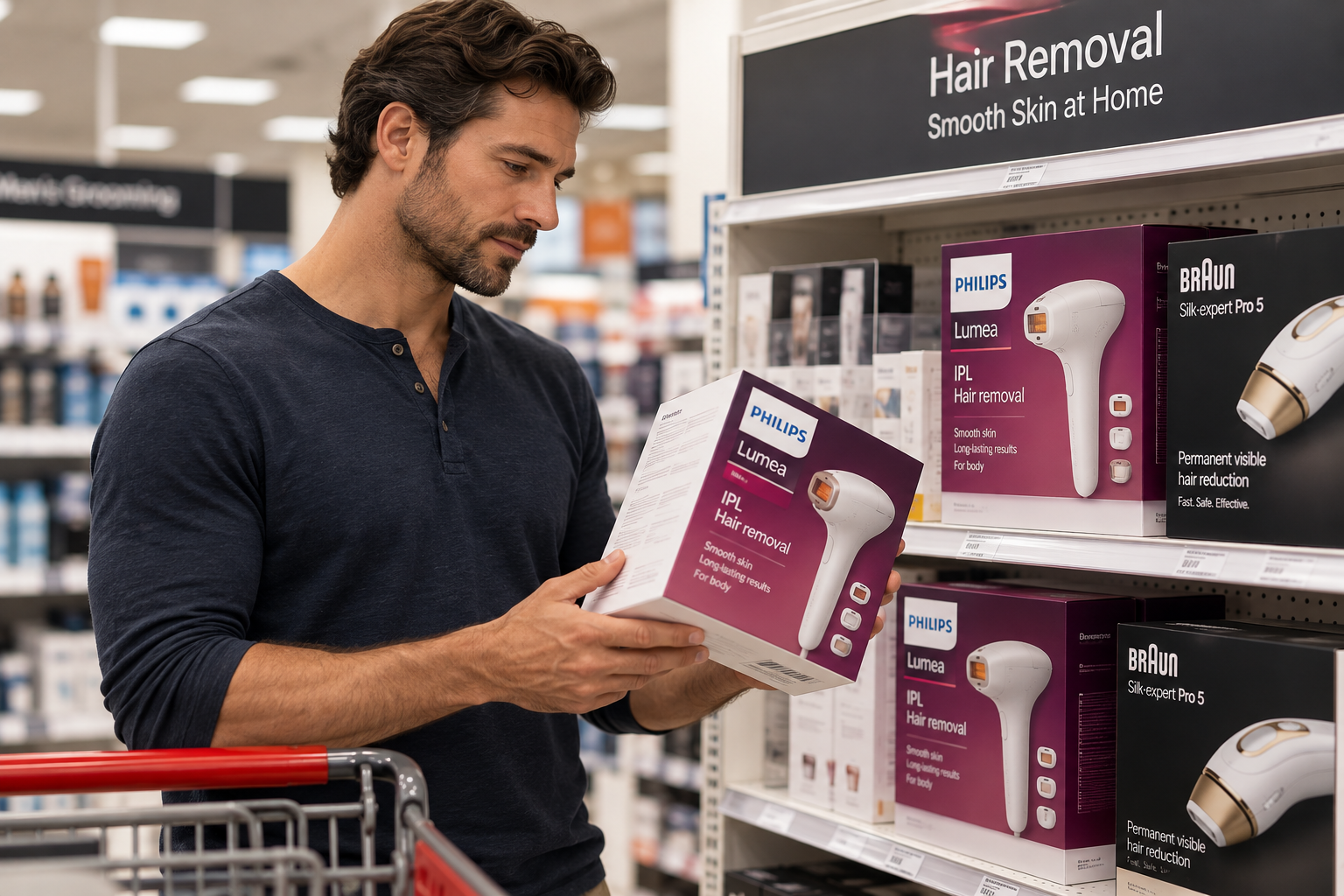
You're looking at a home IPL device that costs a few hundred dollars. Professional laser hair removal could cost considerably more. Both promise less unwanted hair. So why pay someone else to do it?
For some men, you may not need to. A well-chosen at-home IPL device can produce meaningful hair reduction when your skin and hair are compatible, the treatment area is permitted, and you follow the instructions consistently. But home IPL and professional laser are not interchangeable. The differences matter most when you're treating your back, beard, intimate areas, darker skin, or a carefully planned amount of body hair.
Here's how to decide which route is worth it for you.
First, the device you're shopping for probably isn't a laser
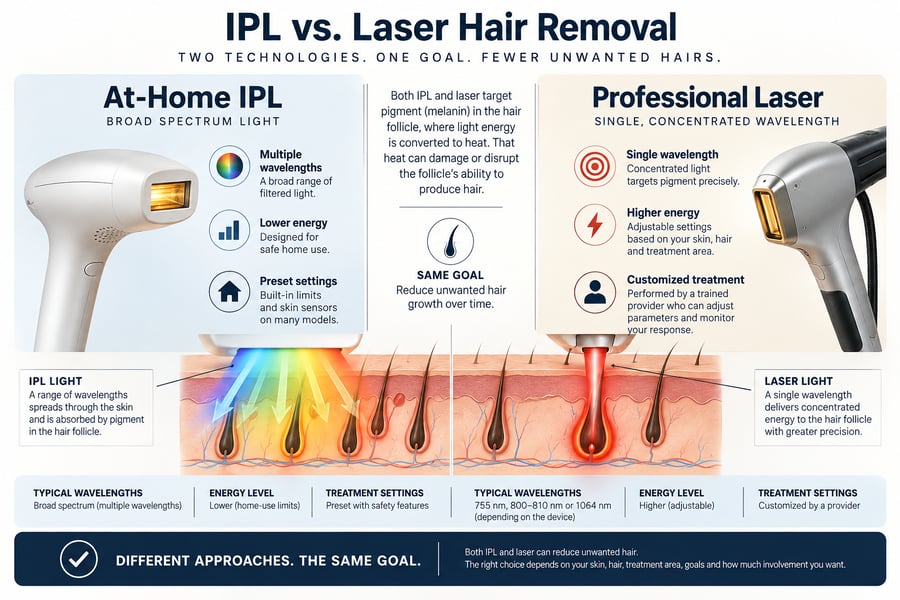
Many products advertised as “at-home laser hair removal” are actually intense pulsed light (IPL) devices. IPL uses flashes containing a range of filtered wavelengths. Laser hair removal uses a concentrated wavelength of light; common professional hair-removal systems include alexandrite (755 nm), diode (often around 800–810 nm), and Nd:YAG (1064 nm) lasers. Both approaches rely on hair pigment absorbing energy, which damages or disrupts the follicle's ability to produce hair.[1][2]
There are exceptions. Genuine consumer laser devices exist, and professional clinics sometimes use high-output IPL for hair reduction. So four categories—not two—are involved: home IPL, home laser, professional IPL, and professional laser. This article mainly compares home IPL with professional laser, because that's the choice many men are trying to make.
Does at-home IPL actually work?
Yes. Home IPL isn't a gimmick. A systematic review of light-based home hair-removal devices found measurable hair reduction after repeated treatments, although the studies varied widely and long-term evidence was limited. A later systematic review of home dermatology devices supported home IPL for hair removal while again noting limitations in the evidence.[1][3]
A 2025 randomized study compared a particular home IPL device with a professional IPL/BBL device on body areas such as underarms, calves, and forearms. At three months, the study reported comparable effectiveness and similar adverse-reaction rates. That's encouraging—but it doesn't show that every home IPL device matches every professional treatment, and it was not a comparison with a professional laser.[4]
Here's what the research doesn't settle neatly: how a particular consumer device will perform on a middle-aged man's dense back or chest hair several years after he starts. We can say home IPL often reduces hair growth. We cannot promise the same percentage of reduction, speed, or durability as a specific professional laser treatment.
At-home IPL vs. professional laser: the practical comparison
| Question | At-home IPL | Professional laser |
|---|---|---|
| Does it reduce hair? | Yes, for suitable users; results vary by device and consistency. | Yes, with established evidence; results still vary. |
| Settings | Consumer presets, intensity levels and/or skin sensors. | Provider may select wavelength and adjust treatment parameters. |
| Schedule | Often weekly or every two weeks initially, then periodic touch-ups. | Usually appointments spaced several weeks apart. |
| Skin-tone suitability | Varies by exact model; some exclude darker skin tones. | Some professional wavelengths accommodate darker skin, with appropriate expertise. |
| Gray/white hair | Generally poor target. | Also generally poor target. |
| Male beard and genitals | Restricted by several major manufacturers; check model instructions. | May be treatable after professional assessment and planning. |
| Back and shoulders | You may need help reaching and covering them evenly. | Provider can see the whole area. |
| Maintenance | Often explicitly recommended by manufacturers. | Sometimes needed after an initial series. |
| Financial cost | Device purchase, typically much less than a professional multi-session series. | Pay per area/session or via available packages or memberships. |
| Who's doing the work? | You. | A professional provider. |
“The professional machine is stronger” doesn't explain enough
Professional laser systems generally offer more treatment capability and adjustment than consumer IPL devices. But quoting one energy number is a poor way to compare them.
Fluence means energy delivered per square centimeter. It matters—but so do wavelength, pulse duration, spot size, hair thickness, skin pigment and cooling. An apparently higher number on one machine doesn't automatically mean a safer or better treatment on your skin. The settings work together.[2]
For example, Candela's GentleMax Pro is a professional platform with a 755 nm alexandrite wavelength and a 1064 nm Nd:YAG wavelength. Candela describes the latter as particularly suited to darker skin types; the platform also offers cooling and adjustable treatment parameters.[2] What a given practice can safely deliver depends on its actual equipment, available handpieces and trained provider—not merely the specifications in a brochure.
The more useful difference is this: a professional can examine the skin and hair, choose appropriate parameters, monitor your response, and adjust the plan. A home device asks you to stay within its built-in operating limits and instructions.
Who is a good candidate for home IPL?
Home IPL makes the most sense when you have adequately pigmented hair, a compatible skin tone, an accessible body area, and enough patience to follow the treatment schedule. Darker, coarser hair often provides a more useful pigment target than gray, white, very pale blond or some red hair. Neither home IPL nor professional pigment-targeting lasers can reliably solve the problem of hair with little melanin.[5]
Skin tone deserves equal attention. Light energy targets pigment in hair, but melanin in skin also absorbs light. Some home devices use skin sensors that reduce output or stop flashing outside their intended range. That protection does not make them suitable for every complexion. Professional laser systems may offer additional wavelength choices, including Nd:YAG for appropriately selected patients with darker skin, but professional treatment isn't automatically safe or effective for everyone.[2][5]
For the fuller discussion, see our guide to laser hair removal for darker skin.
The situations where being a man changes the answer
Your beard and neck
This is an important exception to a lot of packaging that says “face and body.” Braun's U.S. guidance tells men not to use its IPL devices on the face or neck, warning that beard treatment may leave uneven results. Philips Lumea likewise prohibits use on male face, neck and beard-growing areas for the models covered by its guidance.[6][7]
Those are manufacturer-specific restrictions, not a claim that every home IPL ever made is identical. But don't assume a device described as suitable for facial hair is approved for a man's beard. Check its exact manual and model before putting it near your jawline.
Professional beard-line or neck treatment raises its own questions about density, shaping, safety, and permanence. It merits an individualized discussion rather than experimenting on the face with a device whose instructions exclude it.
Your back and shoulders
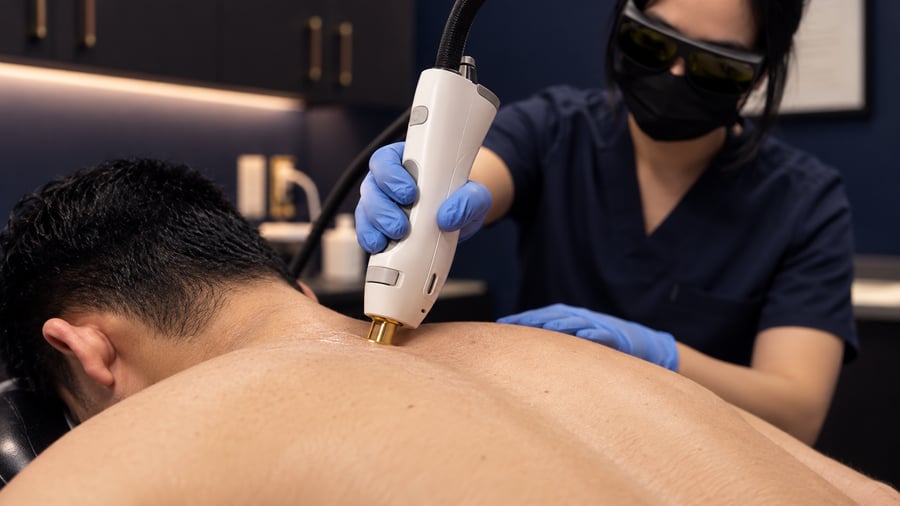
Here's the logistical question product reviews seldom answer: who is going to treat the middle of your back?
A home device may be suitable for back hair according to its instructions. But it doesn't give you longer arms, eyes in the back of your head, or perfectly even coverage. If you have someone willing to help and you're comfortable following the manufacturer's instructions together, that's one thing. If you're on your own, repeatedly covering the back and shoulders can become the deciding factor.
For a deeper look at the area itself, read Back Hair Removal for Men.
Large areas: chest, stomach and legs
These are where home IPL can be a reasonable proposition. You can see and reach much of your own chest and legs, and you don't have to make an appointment. Some consumer devices advertise quick flashes and glide modes. But the manufacturer's time estimate is not the whole time commitment: account for preparation, covering the complete area, repeat sessions, and future maintenance.
Don't assume a professional appointment is automatically quicker for every area, either. Large professional treatment areas can still take substantial time.[5] The advantage is that the provider does the coverage while you are there.
Your private areas
“Bikini line” does not mean “safe on every part of a man's genitals.” Braun's U.S. advice tells men not to use its IPL devices in intimate areas. Philips Lumea says men must not use the covered models on the penis, scrotum, perineum or around the anus. Philips also excludes the male face and neck.[6][7]
Professional practices like Flycatcher treat these areas, but intimate-area laser hair removal requires careful assessment of the skin, hair and anatomy. If that's your goal, our guide to laser hair removal for men's privates discusses the professional option.
Tattoos
Don't flash IPL directly over a tattoo. Light absorbed by tattoo pigment can produce unwanted heating and injury; the same basic caution applies to professional hair-removal lasers. A tattoo also changes the final grooming pattern because the tattooed area must be excluded from light-based hair removal. See how laser hair removal works around tattoos.
What if you want less hair—not no hair?
Some men want a smoother chest. Others want to keep chest hair, thin out their shoulders, and remove the worst of their back hair. That's a different destination.
You can stop home IPL when you like the result, but you must judge your own coverage and what you want each body area to look like. A professional provider can discuss boundaries and transitions, document how the hair responds, and adjust subsequent treatment areas or timing. No one can promise to dial in an exact percentage of reduction. Hair grows in cycles, and the pattern changes across a series.
At Flycatcher, clients ordinarily see Aurora throughout their laser series. That continuity allows her to build familiarity with prior settings, skin reactions, hair patterns and the degree of reduction each man wants. Changing providers doesn't automatically produce worse results; good documentation matters too. But a familiar provider can be helpful when the goal is more nuanced than “remove everything.”
Will home IPL leave you looking patchy?
It can, particularly if you miss sections or treat some patches more consistently than others. But temporary unevenness is not unique to home IPL. Both home and professional light-based treatments work across hair growth cycles; hairs don't all respond at exactly the same time. Even professionally treated areas may look irregular between sessions.
If natural-looking thinning is the goal, pay attention to the transition between treated and untreated areas. A cleanly reduced shoulder adjoining a hairy upper arm may draw more attention than a gradual transition. We explain this further in our guide to thinning body hair naturally.
How often will you actually use home IPL?
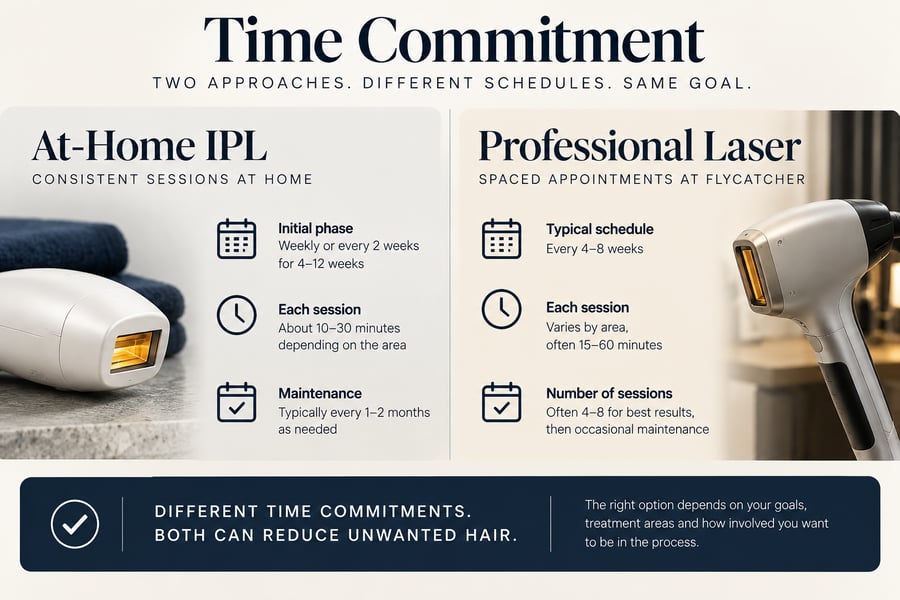
Manufacturers vary. Braun recommends weekly treatments for approximately four to twelve weeks, followed by maintenance tailored to regrowth, often around every one to two months. Philips Lumea specifies four treatments two weeks apart, followed by touch-ups roughly every four weeks for the models in its current instructions.[6][8]
That means the device isn't necessarily a one-time project. You may use it repeatedly for months and then revisit it periodically. Professional laser also requires an initial series, commonly with several weeks between visits, and some people need later maintenance.[5]
Neither approach guarantees a lifetime without regrowth. The practical difference is who performs the treatments and manages follow-up.
What about safety?
Home devices include safeguards and may be appropriate for self-use within their instructions. That doesn't eliminate the possibility of burns, blistering, eye exposure, or pigment changes if they're misused or applied to unsuitable skin or areas. A skin-tone sensor cannot override the manual's restrictions.[1][6][7]
Professional treatment isn't risk-free either. At Flycatcher, provider assessment, appropriate settings and aftercare are important parts of treatment because improper laser use can cause burns, pigment changes and, occasionally, scarring.[5]
The distinction is restricted self-use versus treatment planned and performed by a trained professional. Neither approach is risk-free.
One more label worth understanding: an IPL device described as FDA cleared through the 510(k) pathway is not thereby FDA approved. Clearance is based on substantial equivalence to an appropriate predicate device; it does not certify that every device performs the same way or can be used on every body area.[9]
What does each choice really cost?
A home IPL device commonly involves an upfront purchase in the hundreds of dollars, potentially plus any model-specific replacement parts. It can treat multiple permitted areas with no per-visit charge. If you use it reliably, that can be substantially cheaper than a professional multi-session series.
Professional prices depend on the area. For context, Flycatcher's published single-treatment area tiers range from $99 for extra-small areas to $499 for extra-large areas; a full-back individual treatment is $349.
Imagine two men. One wants less hair on both legs, can reach the entire area, has compatible skin and hair, and doesn't mind doing routine touch-ups. Buying a home IPL device could be a sensible financial decision. The other wants to reduce thick back hair and shape a natural transition onto his shoulders, but cannot treat the whole area himself. Professional treatment might be more valuable to him despite the higher price.
Don't count your own time as free just because the treatment happens at home. But don't pretend convenience and saving money aren't meaningful advantages, either.
Should you try home IPL first?
Yes, it can be reasonable if your device permits the body area, your skin and hair fit its compatibility chart, you are comfortable with its precautions, and you're willing to complete the initial schedule and maintenance. Particularly for accessible areas, home IPL may be all you need to meet your goals.
Consider professional laser instead when a home device excludes your intended area, your skin or hair needs individualized assessment, or you would rather have someone else manage the treatments.
Can you use home IPL after professional laser—or professional laser after home IPL?
Home IPL might be considered for minor regrowth or maintenance after professional treatment, but don't invent your own overlapping schedule. Before using it, check the device's instructions and discuss timing, skin condition and the treatment area with your provider.
The reverse sequence is more interesting. One small randomized study examined diode laser treatment after prior professional IPL sessions and reported that prior IPL appeared to reduce the laser's subsequent effect. The authors proposed that thinner, less-pigmented remaining hairs gave the later laser less to target.[10]
But that study involved 45 young women and professional IPL—not men using today's consumer devices at home. We cannot conclude that trying home IPL first will ruin your chance of successful professional laser hair removal. If you've already used home IPL, simply tell your provider what you used, where, and when. That history can inform an appropriate assessment.
The bottom line: when is home IPL good enough?
If you want modest-to-meaningful hair reduction on reachable areas, have compatible skin and pigmented hair, and are disciplined about following the instructions, home IPL may be an excellent value. It's a legitimate choice—not a compromise you should feel embarrassed about.
Professional laser becomes worth considering when the technology or anatomy calls for more expertise, the hair is difficult to reach consistently, you want closer supervision, or your aesthetic goal involves deliberately managing which hair stays and which goes.
For Austin-area men weighing the options, Flycatcher offers a complimentary laser hair removal consultation. We can assess your hair, skin, treatment area and desired degree of reduction—and tell you when home IPL could be a reasonable choice. Call (737) 239-0112 to schedule.
- Thaysen-Petersen D, et al. A systematic review of light-based home-use devices for hair removal and considerations on human safety. J Eur Acad Dermatol Venereol. 2012. PubMed.
- Candela Medical. Gentle Pro Series: GentleMax Pro, wavelengths, cooling and applications. Manufacturer documentation.
- Home-based devices in dermatology: a systematic review of safety and efficacy. 2021. PubMed.
- Yan Y, et al. Comparison of the efficacy and safety of home-used intense pulsed light with medical intense pulsed light for hair removal. Lasers Med Sci. 2025. PubMed.
- American Academy of Dermatology. Laser hair removal: FAQs. AAD.
- Braun US. Help Center: IPL use by men, body-area restrictions, hair compatibility, and schedules. Braun.
- Philips. Can Philips Lumea be used by men too? Philips.
- Philips. How often should I use my Philips Lumea? Philips.
- U.S. Food and Drug Administration. 510(k) Clearances. FDA.
- Atta-Motte M, Zaleska I. The results of the diode laser hair reduction treatments after the IPL hair reduction treatments. J Cosmet Laser Ther. 2020/2021. PubMed.
