

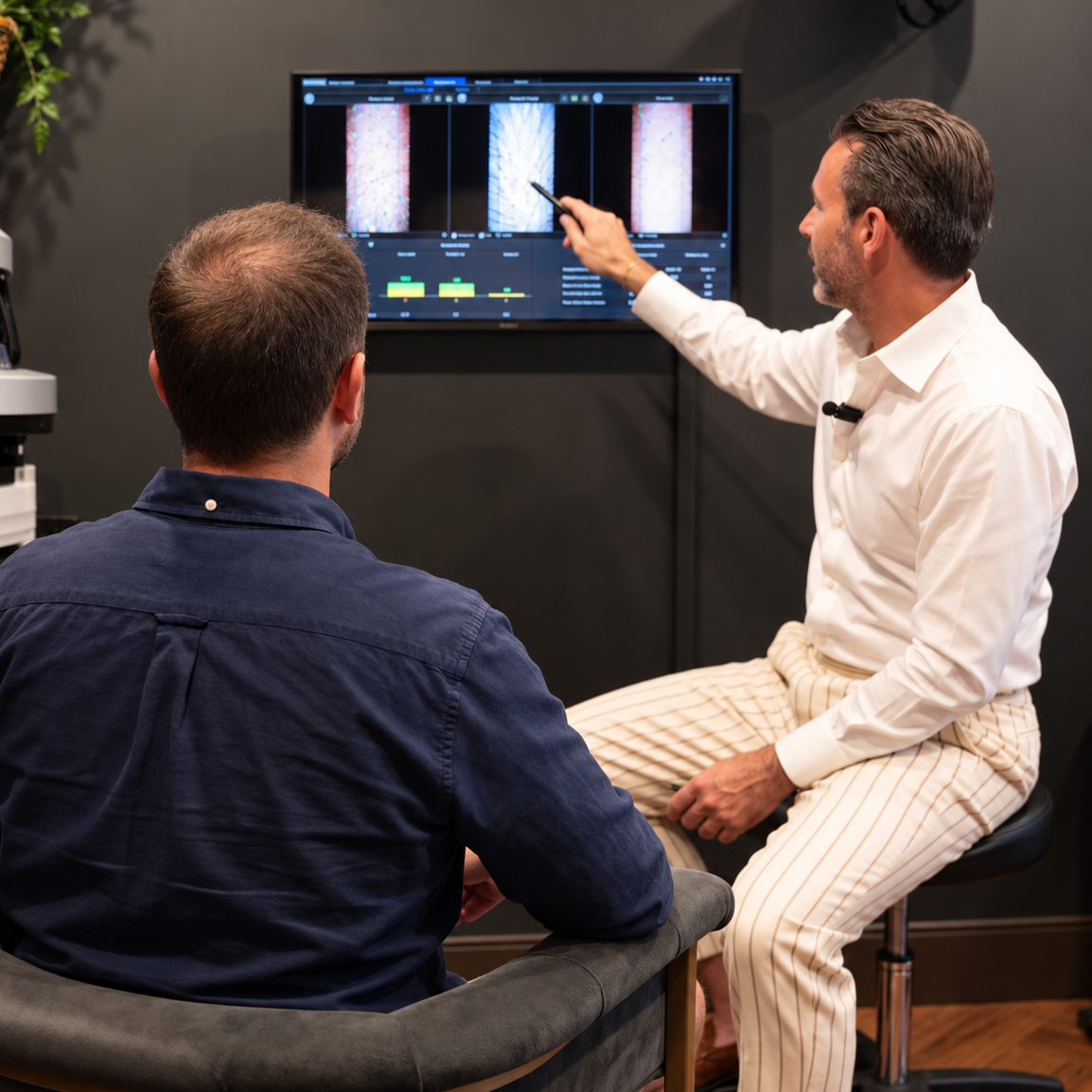
If you’re researching PRP for hair loss in Austin, you’ll probably encounter two very different messages.
The first is simple: PRP uses your own blood, growth factors are involved, and it can help regrow hair.
The second is considerably more skeptical: the studies are inconsistent, PRP protocols vary, and you may spend thousands of dollars without knowing exactly what you’ll get.
The evidence sits somewhere between those extremes.
PRP has a legitimate and growing clinical evidence base for androgenetic alopecia, or male-pattern hair loss. Research suggests it can improve hair density for some patients. But results vary, evidence for increasing individual hair thickness is less consistent, and there is still no universally standardized way to prepare or administer PRP for hair loss. [1]
There’s also a more basic question that tends to get skipped:
What are you asking PRP to do?
Hair loss is not one problem. PRP is one treatment modality. Before choosing it—or any other hair-loss treatment—it makes sense to understand what kind of hair loss you have, how much viable hair remains, whether your loss is still progressing, and whether your primary job is to preserve hair, improve thinning hair, or replace coverage that is already gone.
That distinction can save you a considerable amount of money and frustration.
Additional Reading: Men’s Hair Loss: Causes, Early Signs, Treatments & What Actually Works
What Is PRP Hair Restoration?
PRP stands for platelet-rich plasma.
A provider draws a small amount of your blood and processes it in a centrifuge to separate and concentrate the platelet-containing portion. That platelet-rich plasma is then injected into areas of the scalp where hair is thinning. [2]
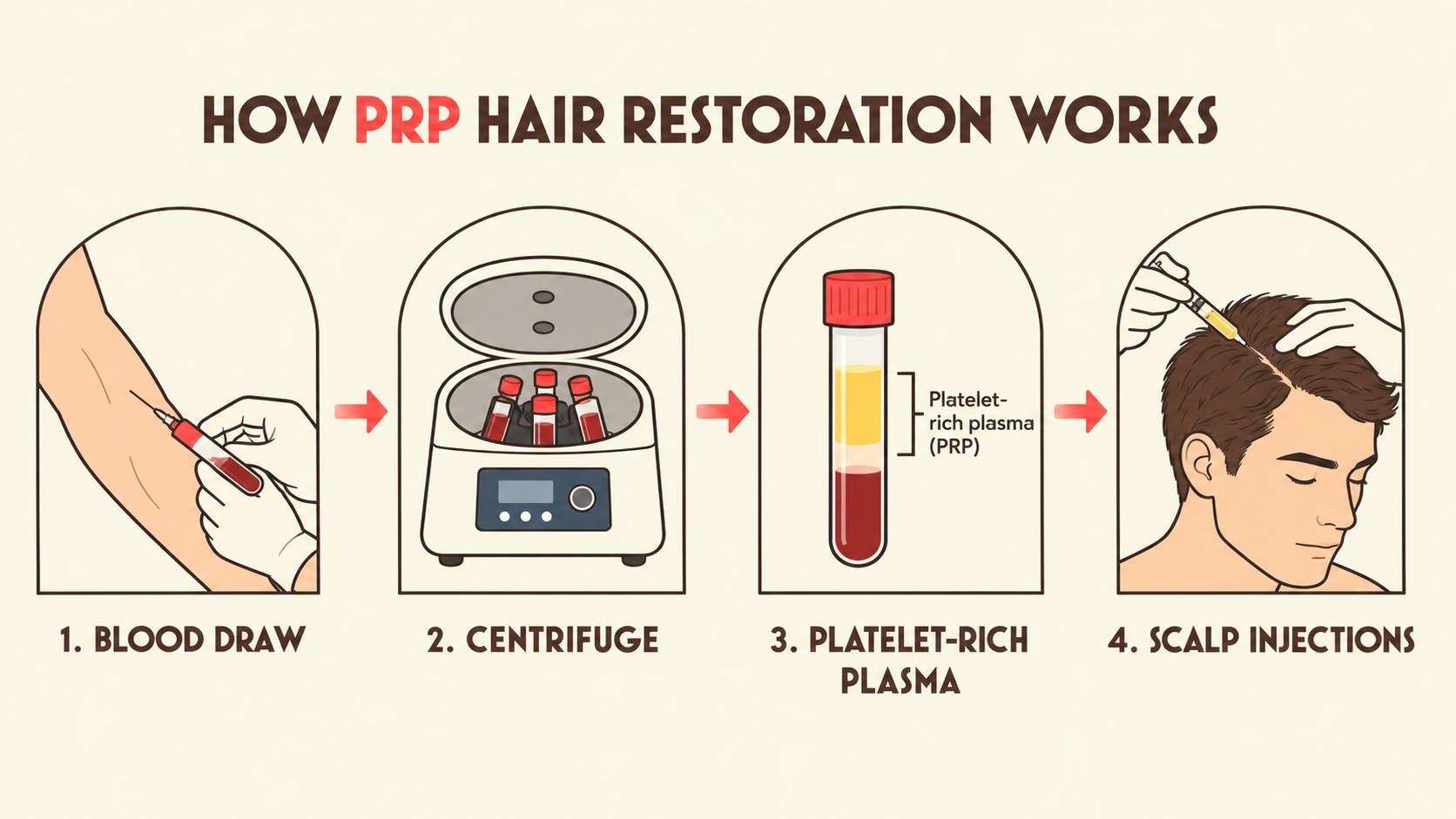
Platelets contain signaling proteins and growth factors involved in tissue repair and cellular activity. That provides a plausible biological reason for studying PRP as a hair-loss treatment—but biological plausibility by itself does not prove that a treatment meaningfully grows hair. That’s why the clinical studies matter.
There are two practical details worth understanding from the beginning.
First, PRP is minimally invasive, not non-invasive. There is a blood draw followed by multiple scalp injections.
Second, “PRP” does not necessarily describe one identical product or protocol from clinic to clinic.
Does PRP Actually Work for Male Hair Loss?
The best answer today is:
PRP appears capable of improving hair density in androgenetic alopecia, but the size and predictability of the benefit remain uncertain.
A 2024 systematic review and meta-analysis evaluated 14 randomized studies involving 431 patients, with 13 included in the quantitative analysis. Researchers calculated an average advantage of about 27.6 hairs per square centimeter for PRP. But the studies varied substantially, the authors graded the evidence as low quality, and publication bias was evident. [1]
Hair diameter was a different story. That same meta-analysis did not find a statistically significant improvement in hair diameter.
A separate 2024 systematic review focused specifically on men with androgenetic alopecia. It included eight randomized trials and one prospective cohort involving 291 men. Six studies reported a significant improvement in hair density versus the comparison treatment. But the reviewers also found generally low-quality evidence, moderate risk of bias, and considerable differences among the studies. [3]
A larger 2025 meta-analysis included 43 randomized trials and 1,877 participants across multiple forms of alopecia. It found evidence supporting improvement in hair density and reduction in hair loss, while hair-thickness results were less convincing overall. The researchers again identified meaningful variability in PRP composition and administration. [4]
So we wouldn’t tell a guy in Austin that “PRP definitely works.”
We also wouldn’t tell him that the science is too weak to take seriously.
There is meaningful evidence that PRP can improve hair density for some patients. The harder question is how much improvement an individual man should expect—and whether the PRP protocol being offered to him resembles the protocols that generated positive results in clinical studies.
One Clinic’s PRP May Not Be the Same as Another Clinic’s PRP
This is one of the most important things to understand when comparing providers.
PRP sounds like a standardized medication. It isn’t.
Studies have used different blood volumes, centrifugation techniques, numbers of spins, platelet concentrations, leukocyte concentrations, activation methods, injection depths, injection volumes, and treatment intervals.
A systematic review examining PRP preparation for androgenetic alopecia found inconsistent reporting of even basic preparation variables. Only 21% of the studies reviewed reported all of the preparation factors researchers were examining, while only 32% reported platelet counts for both the original blood sample and the finished PRP. [5]
That helps explain why two clinics can both advertise “PRP hair restoration” without necessarily delivering exactly the same treatment.
You may also see PRF, or platelet-rich fibrin, advertised alongside PRP. If a provider groups the two together, ask exactly which treatment you are receiving and why it was selected for you.
How Many PRP Hair Treatments Do You Need?
There is no universally established PRP schedule.
That said, three or more treatments spaced about a month apart appear frequently in both the clinical literature and clinical practice.
A dermatology consensus statement recommended three to five PRP sessions separated by about one month for androgenetic alopecia. [6]
The American Academy of Dermatology describes a schedule of monthly PRP injections during the first three months followed by maintenance treatments every three to six months. [2]
That does not mean every man needs exactly three treatments followed by PRP twice a year.
It means that when you’re comparing costs, the price of one session isn’t a very useful number by itself.
You need to know what the provider considers an initial treatment course, how that plan may change based on your response, and what ongoing maintenance may cost.
What Does PRP Hair Restoration Cost in Austin?
We checked publicly posted Austin-area pricing on September 22, 2026.
We’re deliberately including only practices that publish an actual hair-restoration PRP or PRP/PRF price. If a provider doesn’t publicly state what the treatment costs, it isn’t included in this comparison.
| Austin-area provider | Published price | What that means |
|---|---|---|
| W Aesthetics | $650 | Hair restoration is listed under PRP/PRF at $650. A one-time $30 medical-clearance fee is listed for new clients. [7] |
| Skin Pharm West Lake Hills | $900 per treatment $2,475 for three |
The three-treatment package works out to $825 per treatment. [8] |
| Beverly Hills Rejuvenation Center | $950 per session | Its hair-restoration page describes an initial course of three to four sessions, putting the published initial-course cost at roughly $2,850 to $3,800 before maintenance. [9] |
The takeaway isn’t that $650 is cheap and $950 is expensive.
It is that a realistic PRP budget usually needs to account for a series, not one appointment.
At currently published Austin prices, three treatments can range from $1,950 if each session costs $650 to $2,850 at $950 per session. Skin Pharm’s published three-treatment package is $2,475. Four treatments at $950 each would total $3,800.
Then there may be ongoing maintenance.
That’s why comparing PRP with medication, red light therapy, or a comprehensive hair-restoration program based only on “price per treatment” can become misleading quickly.
Additional Reading: How Much Does Non-Surgical Hair Restoration Cost in Austin?
What Does PRP Treatment Actually Feel Like?
The process isn’t surgery, and most guys can return to normal activities quickly.
But it also isn’t nothing.
You first have blood drawn. Your blood is processed, and the resulting PRP is then delivered into the treatment area of the scalp. Depending on the provider and technique, numbing or other comfort measures may be used.
Injection-related discomfort, tenderness, redness, swelling, bruising, and occasional headache have been reported in the literature. Serious adverse events have been uncommon in published PRP hair-loss studies. [10]
The American Academy of Dermatology describes PRP as an office-based procedure requiring repeat injections rather than a surgical recovery. [2]
For plenty of men, that’s a perfectly acceptable tradeoff.
Some guys simply aren’t bothered by needles. If a blood draw and repeated scalp injections don’t faze you, invasiveness may rank pretty low on your list of deciding factors.
For someone else, the blood draw and injections may be exactly why he wants to understand his other options.
Neither preference tells you which treatment will produce the better biological response.
Who Is PRP Most Likely to Make Sense For?
Most of the meaningful PRP evidence involves androgenetic alopecia, better known as male-pattern hair loss.
That’s important because “I’m losing hair” is not a diagnosis.
Men can lose hair because of androgenetic alopecia, telogen effluvium, medications, significant weight loss, inflammatory or autoimmune conditions, nutritional problems, and other causes. Different problems call for different responses. The American Academy of Dermatology specifically emphasizes identifying the type of hair loss because treatment depends on the cause. [11]
PRP also needs viable follicles to work with.
It does not create a new supply of follicles or move follicles from one part of your head to another.
That distinction becomes increasingly important as hair loss advances.
A man with miniaturizing hair throughout the crown is facing a different problem than a man with a long-established bald area where meaningful cosmetic coverage has already disappeared.
At that point, the question may begin shifting from “How do I improve the follicles that are still here?” to “Do I need to replace coverage?”
That second job belongs to hair transplantation, not PRP.
Additional Reading: Hair Transplant vs. Non-Surgical Hair Restoration in Austin: Which Makes Sense for You?
PRP Is a Treatment. It Isn’t a Complete Hair-Loss Strategy.
This may be the most important thing in this article.
Hair restoration makes more sense when you stop thinking in terms of products and start thinking in terms of jobs:
Understand what’s happening → Preserve viable hair → Improve viable hair → Replace lost coverage when necessary.
PRP mostly sits in the improve viable hair part of that framework.
Imagine a 42-year-old man with progressive androgenetic alopecia. He still has plenty of hair, but his follicles are gradually miniaturizing because they are genetically susceptible to androgen activity.
PRP may potentially improve density.
What PRP hasn’t done is make his genetic tendency toward progressive hair loss disappear.
That’s why the treatment conversation may also include preserving the hair he has with medication, measuring whether follicles are continuing to miniaturize, and tracking whether treatment is actually changing the trajectory.
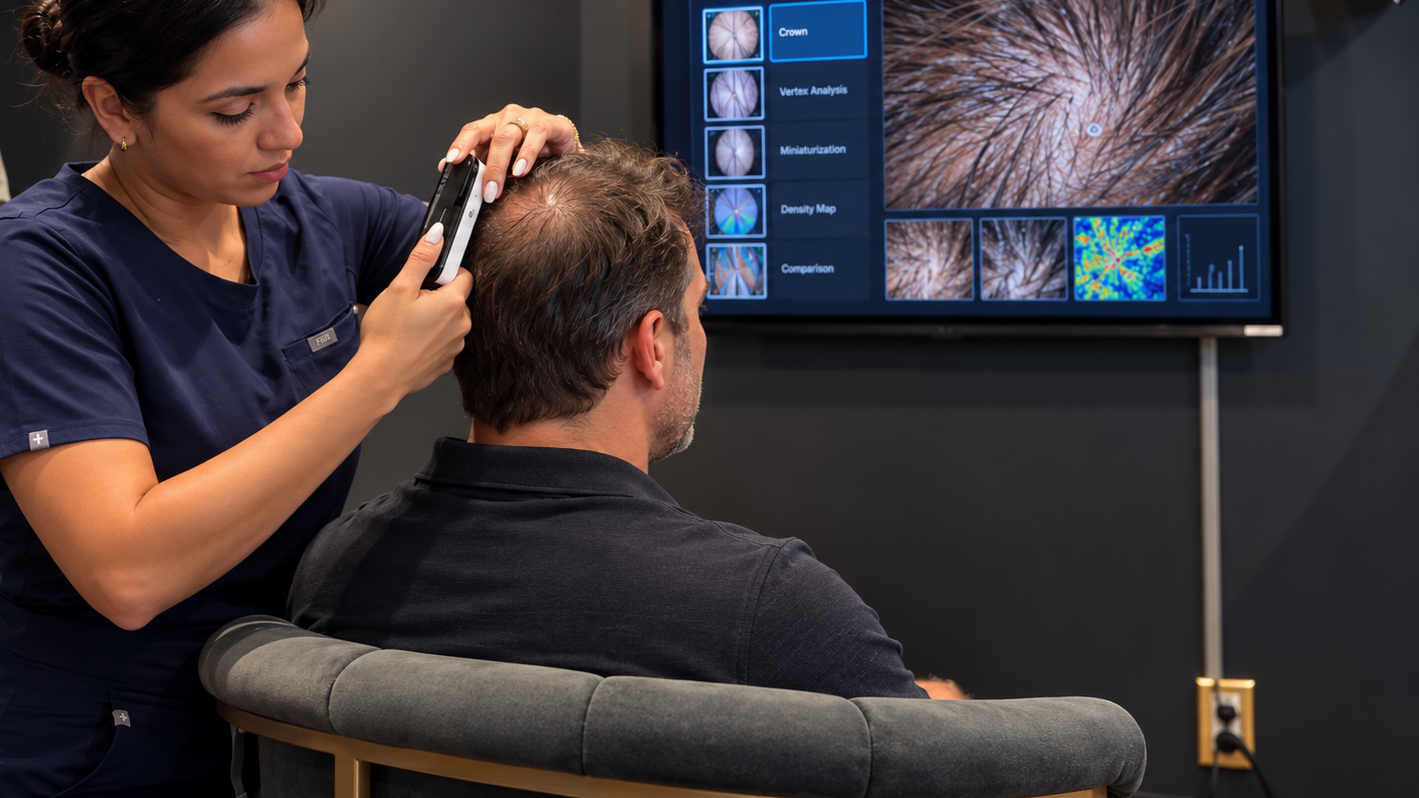
This is also why we like objective baseline measurements rather than relying solely on bathroom-mirror impressions or photographs taken under different lighting.
If you’re spending several thousand dollars on your hair, “I think it looks a little better” shouldn’t be the only metric available to you.
What Else Should You Understand Before Choosing PRP?
PRP isn’t the only non-surgical treatment with clinical evidence behind it.
Finasteride is FDA-approved for male-pattern hair loss in men. It inhibits type II 5-alpha-reductase, the enzyme involved in converting testosterone to dihydrotestosterone, or DHT. [12] It is particularly relevant when the job is slowing progressive androgen-driven miniaturization. If you’re weighing the medication side of treatment, read our guide to finasteride side effects, libido, and dutasteride.
Topical minoxidil is an FDA-approved over-the-counter hair-regrowth treatment for men. Continued use is necessary to maintain treatment-dependent regrowth. [13]
Low-level laser or light therapy is another non-invasive option. A 2025 systematic review and meta-analysis evaluated 38 studies involving 3,098 patients, most with androgenetic alopecia, and found evidence supporting improvement in hair density with LLLT compared with placebo. [14] We break that option down separately in Red Light Therapy for Hair Growth: Benefits, Best Options & Costs.
Microneedling has also been studied, especially in combination with established treatments. A 2024 meta-analysis included 13 randomized trials involving 696 patients with androgenetic alopecia and found supportive evidence for combination microneedling approaches. [15]
Personalized prescription treatment may also be part of a broader plan when a prescribing clinician determines medication is appropriate.
And sometimes the best answer isn’t choosing one of these.
Hair restoration is often a combination-treatment problem because preservation, stimulation, and replacement are different jobs.
How Is CryoWave Different From PRP?
At Flycatcher, we don’t offer PRP.
Our in-office needle-free option is CryoWave CX, which uses cryo-chilled carbon dioxide with a topical hydrogel treatment as part of the GetHairMD system.
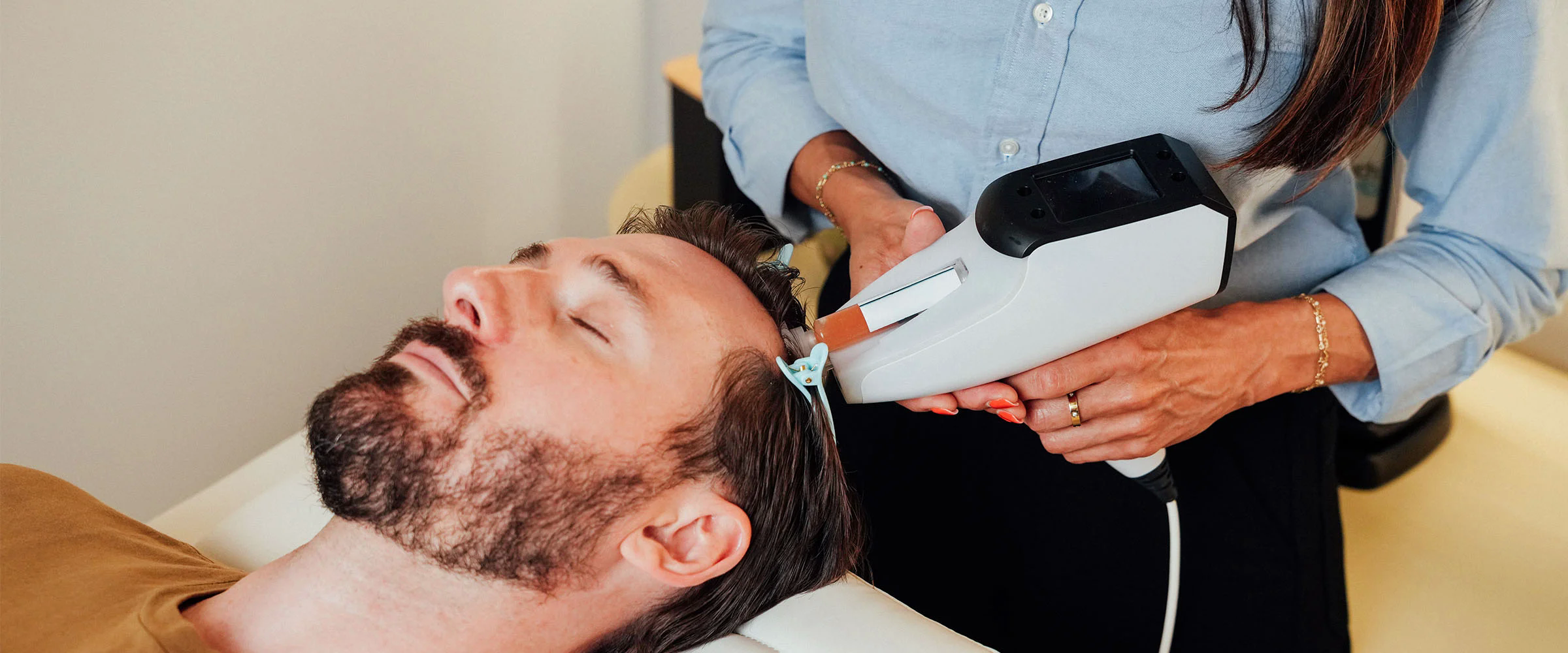
CryoWave CX, Flycatcher’s needle-free in-office hair-restoration option.
The practical differences are straightforward.
| PRP | CryoWave CX | |
|---|---|---|
| Blood draw | Yes | No |
| Scalp injections | Yes | No |
| Treatment category | Minimally invasive | Needle-free / non-invasive |
| Published clinical evidence | Multiple randomized trials and systematic reviews | Early device-specific evidence |
| Evidence limitation | Substantial variability in preparation and treatment protocols | Very small uncontrolled combination-treatment study |
| Treatment model | Commonly performed as an initial series followed by maintenance | Used as an in-office adjunct within a broader GetHairMD plan |
| Current Flycatcher price | Not offered | $399 with TrichoBoost; $1,999 for six treatments |
And this is where we need to be very clear about the science.
PRP currently has a substantially larger and more mature published clinical evidence base than CryoWave.
The device-specific CryoWave research includes an uncontrolled study involving six participants—five men and one woman—with advanced androgenetic alopecia. Subjects did not receive the in-office cryo-carboxy treatment by itself. The protocol also included daily topical and oral botanical treatment, which means the study cannot isolate how much of the observed change came from the device alone. [16]
The study is useful as an early clinical signal. It is not evidence that CryoWave produces better results than PRP—or equivalent results.
So we don’t think the useful comparison is:
PRP versus CryoWave: Which one wins?
They are treatments with different evidence maturity and very different treatment experiences.
A guy who values PRP’s larger clinical literature and isn’t bothered by injections may reasonably prefer PRP.
A guy specifically looking for a needle-free treatment may want to understand CryoWave—but he should also understand that its device-specific clinical evidence is much earlier.
That practical comparison deserves its own article, so we’ll leave the deeper PRP-versus-CryoWave discussion there rather than turning this entire piece into a head-to-head contest.
What Should You Ask an Austin PRP Provider Before Paying for a Series?
If you’re meeting with a PRP provider in Austin, these questions are more useful than simply asking whether PRP “works”:
- What type of hair loss do I actually have?
- How was that determined?
- What PRP preparation system and protocol do you use?
- How many sessions are included in the recommended initial plan?
- What does the entire initial series cost?
- What maintenance schedule do you typically recommend, and what does each maintenance session cost?
- How will you objectively measure whether I’m responding?
- What else should I be doing to preserve the hair I still have if my androgenetic alopecia is progressive?
- At what point would you decide PRP isn’t producing enough benefit to justify continuing?
A provider should be able to have that conversation without needing PRP to be the answer to every question.
So, Is PRP Worth Considering?
PRP can be a reasonable option if you have the right kind of hair loss, realistic expectations, and a treatment plan that makes sense beyond the injections themselves.
PRP has enough clinical evidence that we wouldn’t dismiss it simply because Flycatcher doesn’t offer it. The research is particularly encouraging around improvements in hair density.
But there are still important limitations. PRP preparation isn’t standardized. Results vary. Hair-thickness findings are less consistent. Maintenance may become part of the long-term cost. And PRP doesn’t eliminate the need to understand why you’re losing hair in the first place.
That’s why we think the first decision should come before PRP, CryoWave, red light, medication—or even a transplant:
Figure out what’s happening to your hair.
Then decide what job needs to be done.
Start With the Hair, Not the Treatment
If you’re an Austin-area man trying to decide between PRP and other hair-restoration options, Flycatcher offers a Complimentary Scalp & Hair Health Consultation that includes a full hair analysis.
The purpose isn’t to convince you that you need a particular procedure. It’s to get a better look at what’s happening, establish a baseline, and talk through the appropriate options.
Flycatcher is located at 18225 State Highway 71, Suite B200, Austin, TX 78738, about three miles west of The Galleria in Bee Cave and convenient to Bee Cave, Lakeway, Spicewood, and the surrounding Texas Hill Country. Call or text (737) 239-0112.
If you’re not ready for a consultation, start with Flycatcher’s Two-Minute Hair Check.
References
- Kieling L, Konzen AT, Zanella RK, Valente DS. Is autologous platelet-rich plasma capable of increasing hair density in patients with androgenic alopecia? A systematic review and meta-analysis of randomized clinical trials. Anais Brasileiros de Dermatologia. 2024;99(6):847–862.
- American Academy of Dermatology Association. What is male pattern hair loss, and can it be treated?
- The role of platelet-rich plasma in androgenetic alopecia: A systematic review. Journal of Cosmetic Dermatology. 2024.
- Anitua E, Tierno R, Alkhraisat MH. Platelet-Rich Plasma in the Management of Alopecia: A Systematic Review and Meta-Analysis of Clinical Evidence. 2025.
- Kramer ME, Keaney TC. Systematic review of platelet-rich plasma (PRP) preparation and composition for the treatment of androgenetic alopecia. Journal of Cosmetic Dermatology. 2018;17(5):666–671.
- Platelet-Rich Plasma in Androgenetic Alopecia. Consensus recommendations. 2021.
- W Aesthetics. Austin treatment pricing. Pricing checked September 22, 2026.
- Skin Pharm West Lake Hills. Austin treatment pricing. Pricing checked September 22, 2026.
- Beverly Hills Rejuvenation Center. Hair Restoration for Thinning Hair & Hair Loss. Pricing checked September 22, 2026.
- Platelet-Rich Plasma for the Treatment of Androgenic Alopecia: A Systematic Review. 2018.
- American Academy of Dermatology Association. Hair loss: Diagnosis and treatment.
- U.S. Food and Drug Administration. PROPECIA (finasteride) prescribing information.
- DailyMed. Minoxidil Topical Solution USP, 5%.
- Perez SM, Vattigunta M, Kelly C, Eber A. Low-Level Laser and LED Therapy in Alopecia: A Systematic Review and Meta-Analysis. Dermatologic Surgery. 2025;51(2):179–183.
- Efficacy and safety of combined microneedling therapy for androgenic alopecia: A systematic review and meta-analysis of randomized clinical trials. Journal of Cosmetic Dermatology. 2024.
- Niedbala S, Campbell E, Young L, Marcovici G. An Uncontrolled Innovative Test of Cryo-Chilled Carbon Dioxide as a Novel Amplification of a Nano-Botanical Multi-Acting Therapy in Advanced Stage Androgenetic Alopecia. Journal of Complementary Research and Alternative Medicine. 2025;2(1):1–9.
