


If you’re losing your hair, it’s easy to imagine the decision as a ladder.
Start with shampoo. Try minoxidil. Maybe add medication or red light therapy. Spend more on non-surgical treatments. And if none of that works, eventually graduate to a hair transplant.
That’s not really how it works.
Hair transplantation and non-surgical hair restoration solve different problems.
A transplant takes follicles from a donor area—usually the back and sides of the scalp—and moves them to an area where greater coverage is needed. Non-surgical treatment generally works with the hair that is already there: slowing further loss, preserving existing hair and improving hair that is still capable of responding.
Sometimes one approach clearly makes more sense. Sometimes both belong in the same long-term plan.
Flycatcher specializes in non-surgical hair restoration; we do not perform hair transplants. So we have no interest in pretending surgery is somehow the wrong answer for everyone. For some men with established hair loss, a well-planned transplant may accomplish something non-surgical treatment realistically cannot.
The real question is: What job does your hair need done?
The Quick Decision Map: Where Do You Start?
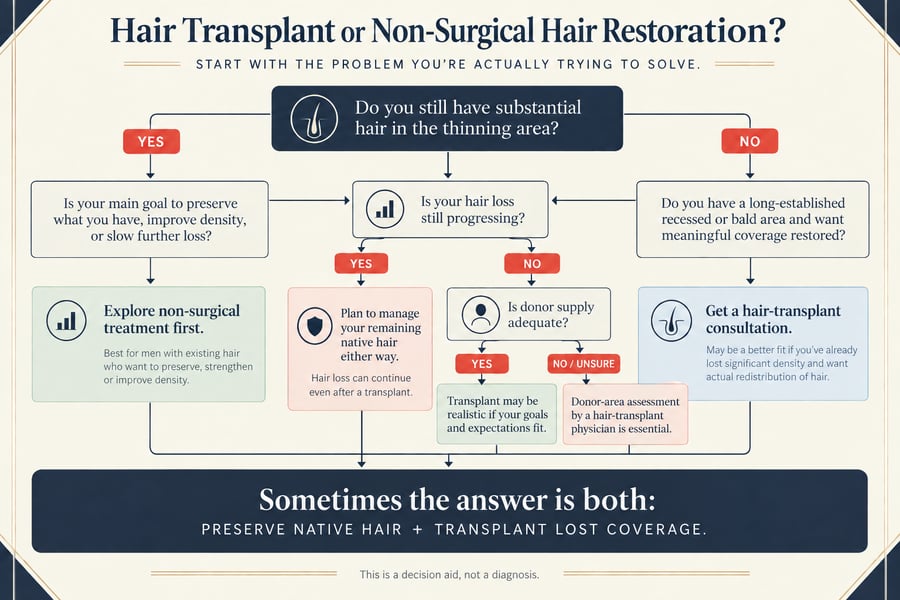
Think of it as a series of questions rather than a contest between treatments.
Do you still have substantial hair throughout the thinning area?
Yes: If your priority is keeping that hair, improving density where possible and slowing further loss, investigate non-surgical treatment first.
No: If you have significant recession or a long-established area with very little remaining coverage and your goal is to put growing hair back into that area, a hair-transplant consultation becomes much more relevant.
Is your hair loss still noticeably progressing?
Yes: Managing the remaining native hair should probably be part of the conversation whether or not you eventually have surgery.
No or relatively stable: A transplant may be easier to plan, assuming you are otherwise an appropriate candidate.
Are you young and your eventual pattern of hair loss is still uncertain?
Yes: It may make sense to focus on diagnosis and preservation before committing limited donor hair to surgery. The American Academy of Dermatology notes that some younger men may be advised to wait on transplantation and begin hair-loss medication first.[1]
No: If your pattern of loss is more established, that particular reason for delaying surgery carries less weight. Donor supply, progression, goals and overall candidacy still determine whether transplantation makes sense.
Do you have adequate donor hair?
Yes: Surgery may be capable of redistributing some of that supply into areas where coverage has been lost.
No or uncertain: You need an experienced hair-transplant physician to assess it before assuming surgery can deliver the density you want.
Are you unwilling to have surgery right now?
That makes non-surgical treatment worth exploring—but it does not mean non-surgical treatment can accomplish everything surgery can.
And there is one more branch men often overlook: Could the answer eventually be both?
Very often, yes.
What Problem Are You Actually Trying to Solve?
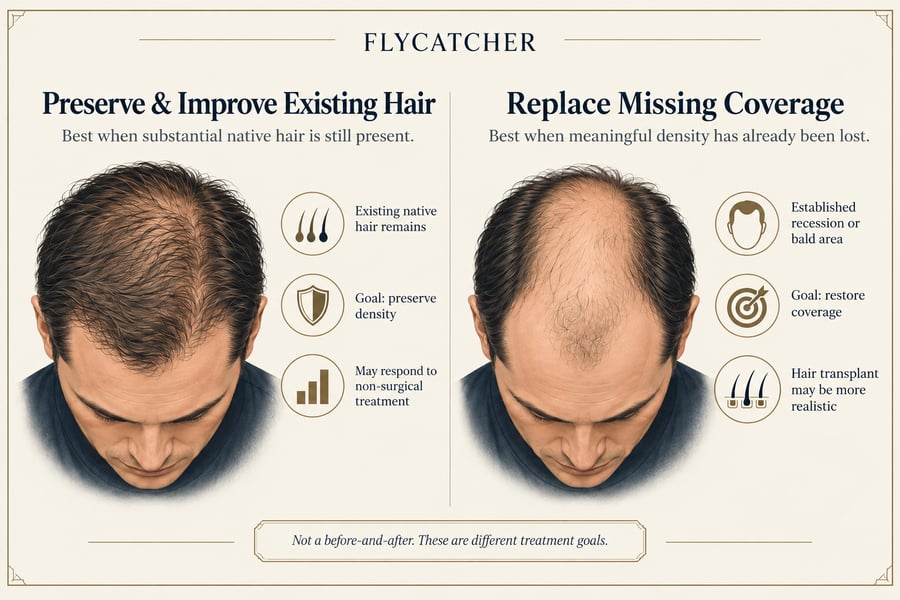
This is the distinction that makes the rest of the decision much easier.
Imagine two men.
The first has noticed that his crown looks thinner under bright light. His individual hairs are getting finer. His hairline has begun creeping backward, but he still has considerable hair across the top of his scalp.
The second has had a deeply recessed hairline for years and wants actual hair growing again at the temples.
Those men may both say, “I want more hair.”
But they do not have the same problem.
The first man may have a meaningful amount of native hair worth preserving and improving. Medication, light therapy or other non-surgical approaches may be appropriate depending on his diagnosis.
The second may be asking treatment to create substantial coverage where very little native coverage remains. That is where transplantation can have an advantage: it can physically relocate donor follicles into that area.
That line should guide much of this decision.
It also works in the other direction. A transplant can add coverage, but it does not necessarily treat what is happening biologically to the rest of your hair.
If You Still Have Considerable Hair, Preservation May Be the First Job
Male pattern hair loss is a process of progressive follicular miniaturization. Hairs that were once thick terminal hairs can become progressively finer and less visible over time.[2]
That means there is an important window between “my hair looks exactly like it always did” and “there is essentially no coverage left here.”
Topical minoxidil and oral finasteride have established evidence for slowing male pattern hair loss and producing partial regrowth, although response varies and treatment has to continue to maintain its benefit.[2] This is one reason it can make sense to act while a meaningful amount of native hair remains rather than waiting until an area has been bare for years.
A non-surgical-first strategy is especially worth exploring when you still have considerable hair throughout the area, your main concern is thinning rather than a large bald area, your loss appears to be progressing, or your primary goal is to preserve as much native hair as possible.
It can also make sense if you are simply not ready for surgery.
That does not mean everyone with thinning hair needs an elaborate hair-restoration program. For some men, medication alone may be a sensible starting point. For others, a broader plan may incorporate prescription treatment, light therapy, objective measurement and selected in-office treatments.
The important part is matching treatment intensity to the problem—not automatically doing more.
If your main concern is the front of your hairline, our guide to receding hairlines in men explains the difference between an evolving hairline and more established recession. And if finasteride is part of the conversation, we have a separate breakdown of finasteride side effects and how it compares with dutasteride.
Additional Reading: Men’s Hair Loss: Causes, Early Signs, Treatments & What Actually Works
If Meaningful Coverage Is Already Gone, Surgery May Be the More Realistic Tool
This is where non-surgical hair-restoration marketing can lose credibility.
There comes a point where telling someone to keep stacking treatments onto a substantially bald area may not be a realistic answer to what he actually wants.
A hair transplant does something fundamentally different: it moves follicles.
Healthy follicles are harvested from a donor region and transplanted into areas where greater coverage is desired. Modern hair transplantation is based on the principle of donor dominance: transplanted follicles generally retain the biological characteristics of the donor area after relocation.[3]
That may make transplantation the stronger option when a man has substantial recession or established bald areas, wants to rebuild the appearance of a frontal hairline, or wants meaningful growing-hair coverage in an area where non-surgical improvement is unlikely to provide enough density.
He also needs an adequate donor supply and realistic expectations about how much coverage that donor supply can provide.
This is precisely why we do not describe non-surgical care as a “replacement” for transplantation.
Sometimes it is an alternative. Sometimes it delays or reduces the need for surgery. Sometimes it works alongside surgery.
And sometimes surgery simply solves the problem more directly.
If Your Hair Is Still Disappearing, a Transplant Does Not Stop That Process
This is probably the most important misconception in the entire article.
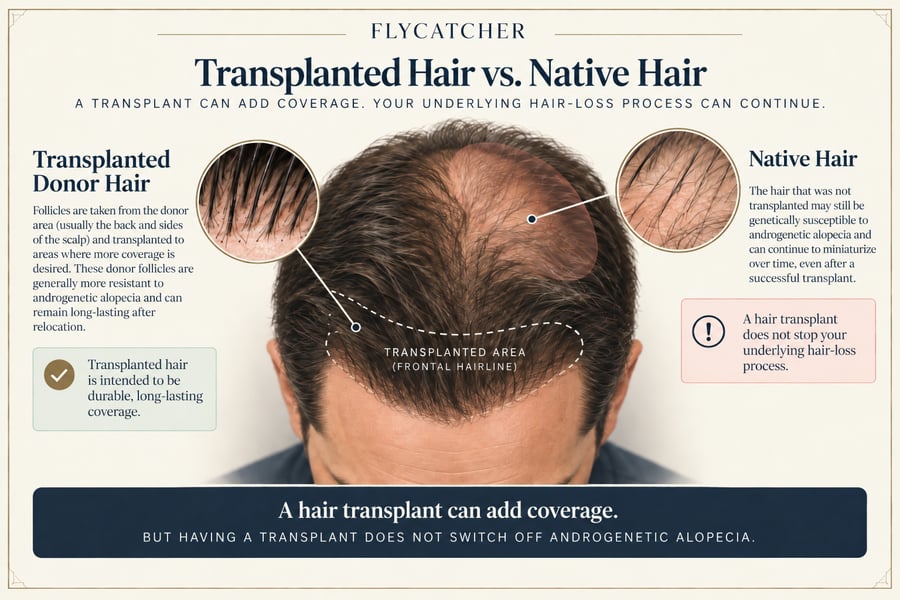
A successful transplant can provide durable transplanted hair.
The genetically susceptible hair that was not transplanted may continue miniaturizing around the transplanted follicles.
The American Academy of Dermatology specifically notes that hair loss and thinning can continue following hair transplantation and that medication may therefore be recommended to help preserve the overall result.[1]
So there are really two populations of hair to think about after surgery:
Transplanted donor hair: Generally selected from areas more resistant to androgenetic alopecia and capable of remaining long-lasting after relocation.
Native hair: The genetically susceptible hair that was never moved and may continue thinning as male pattern hair loss progresses.
That distinction is much more accurate than saying, “Hair transplants aren’t permanent.”
A better way to say it is: The transplanted hair can last. Your underlying hair-loss process can continue.
If You Are Young, Think Beyond the Hairline You Have Today
Being young does not automatically make someone a poor transplant candidate.
But age matters because the earlier hair loss begins, the harder it may be to know how extensive the eventual pattern will become. A surgical-candidacy review identifies very young age, unstable hair loss, poor donor characteristics and unrealistic expectations among the factors that can make transplantation inappropriate or require greater caution.[4]
Consider the problem.
A 25-year-old might have enough donor hair to build an aggressive juvenile-looking hairline today.
But if he eventually loses considerably more native hair behind it, the surgeon now has to find enough remaining donor supply to keep the overall appearance natural decades later.
That is why good surgical planning is not simply: How much hair can we move today?
It is also: How much might we need later?
If You Are Considering Surgery, Donor Hair May Be the Most Important Number
A transplant does not manufacture follicles.
It redistributes them.
And the available supply is limited.
The International Society of Hair Restoration Surgery makes the point plainly: once donor follicles have been transplanted elsewhere, they are not replaced in their original location.[5]
This creates a supply-and-demand problem.
A man can potentially lose more hair across the top of his scalp than he has donor follicles available to replace.
That means a transplant surgeon has to think about donor density, hair caliber and characteristics, the amount of scalp requiring coverage, the patient’s likely future pattern of loss, the density different areas need, and how much donor supply should remain available for later.
This is also why looking at someone else’s transplant and saying, “I want exactly that,” is not particularly useful. His donor supply, pattern of loss and hair characteristics may be completely different from yours.
Additional Reading: How Much Does a Hair Transplant Cost in Austin? 2026 Price Guide
If You Don’t Want Surgery, Consider the Tradeoff: Less Downtime Usually Means More Ongoing Treatment
Surgery has an obvious burden: it is surgery.
There is a procedure, healing period and postoperative care. The AAD notes that transplanted hairs commonly shed in the weeks after a transplant before later regrowth becomes visible.[1]
Non-surgical treatment avoids that surgical recovery.
But it would be misleading to translate “non-surgical” into “do it once and forget about it.”
Medication often requires ongoing use. Light therapy requires consistency. Some in-office treatments are performed as a series and later transition into maintenance.
So this is less a choice between commitment and no commitment than between different kinds of commitment.
Ask yourself which sounds more acceptable: a surgical procedure and recovery with the possibility of ongoing native-hair management afterward, or an ongoing non-surgical routine designed primarily to preserve and improve existing hair?
There is no universally correct answer.
If Price Is Driving the Decision, Compare the Whole Strategy
This is another place where a simple side-by-side price comparison can be misleading.
Based on publicly posted Austin-area prices we reviewed in September 2026, roughly $4,000 to $15,000 is a reasonable planning range for many Austin hair-transplant procedures, although individual cases can fall outside that range. That is not an official Austin average. Our Austin hair-transplant cost guide breaks down the local pricing in detail.
Non-surgical costs have an even wider range.
A medication-only strategy may cost relatively little each month. At the other end, a comprehensive managed program can cost several thousand dollars.
At Flycatcher, our current six-month GetHairMD programs range from $3,000 to $8,000 depending on treatment intensity. Depending on the plan, components may include HairMetrix analysis, HairCodeRx genomic testing, personalized prescription topical treatment, professional or at-home light therapy, CryoWave CX and selected in-office treatments such as TrichoBoost / VITTI-PURE.
Those prices should not be interpreted as “spend $8,000 instead of getting a transplant.”
They are different treatment strategies.
Someone who only needs medication may spend substantially less. If you are comparing lower-cost telehealth medication with a more hands-on in-person model, our GetHairMD vs. Hims, Keeps, Ro and Happy Head comparison explains that distinction separately.
Someone who needs transplantation may be wasting money by repeatedly purchasing non-surgical procedures in an attempt to recreate coverage those treatments cannot realistically deliver.
And someone who has surgery may still choose to spend money afterward managing his remaining native hair.
Compare the total treatment strategy, not just the first invoice.
Additional Reading: How Much Does Non-Surgical Hair Restoration Cost in Austin?
If You Get a Transplant, Non-Surgical Treatment May Still Matter
This is where “transplant versus non-surgical” starts to become the wrong question altogether.
The two approaches can be complementary.
Before transplantation
Medical or non-surgical treatment may sometimes be used to preserve native hair, manage ongoing progression or give a younger patient more time to see how his pattern evolves before committing limited donor supply.
After transplantation
The transplanted follicles and the remaining native follicles are not the same problem.
Medication may be recommended to help protect susceptible native hair. Other non-surgical modalities may also be used depending on the patient’s circumstances and physician’s recommendations.
For example, low-level light therapy has evidence supporting its use for androgenetic alopecia more broadly.[2] If you are considering it after surgery, our article on red light therapy after a hair transplant explains the current evidence and practical timing considerations. Your transplant surgeon should still control your postoperative instructions.
So the long-term plan could conceivably look like:
Preserve what you have → transplant where necessary → continue protecting the native hair around it.
That is not treatment failure.
It is simply acknowledging that replacing lost coverage and managing progressive hair loss are two different jobs.
What If You Have Diffuse Thinning?
This one deserves extra caution.
Seeing hair everywhere but noticing reduced density does not automatically mean non-surgical treatment is the only appropriate choice.
Some men with diffuse patterned thinning can be candidates for transplantation.
But diffuse thinning can also involve the areas normally relied upon for donor hair. A surgical-candidacy review identifies diffuse unpatterned alopecia—where miniaturization extends into the donor region—as a situation in which transplantation may not be appropriate.[4]
That is another reason a flow chart can guide your thinking but cannot diagnose you.
A qualified hair-loss professional needs to determine what kind of loss you actually have before anyone starts selling you surgery or non-surgical treatment.
So: Transplant or Non-Surgical Hair Restoration?
Here is the decision in its simplest form.
If you still have substantial thinning hair and your primary goal is to preserve it:
Start by understanding the cause of the loss and exploring non-surgical treatment.
If you have substantial established loss and want actual growing-hair coverage returned to that area:
Talk with an experienced hair-transplant physician about surgical candidacy and donor supply.
If your hair loss is actively progressing:
Think about how you will manage the remaining native hair regardless of whether surgery is part of the plan.
If you are young and your eventual pattern is still developing:
Be cautious about using too much limited donor hair too early.
If you have insufficient or unstable donor hair:
A transplant may not be a realistic solution, regardless of how much you are willing to spend.
If non-surgical treatment is producing useful preservation or improvement and that satisfies your goals:
You may have no reason to rush into surgery.
If non-surgical treatment cannot realistically create the coverage you want:
Continuing to throw more treatments at the problem may not make sense.
And if you need both preservation and replacement:
The most sensible long-term answer may be a combination.

Start With the Hair You Actually Have
Men often arrive at this question backward.
They start shopping for a solution before anyone has clearly established what problem needs solving.
The first question isn’t: “Transplant or no transplant?”
It is: “What is actually happening with my hair, how much useful hair remains, how is the loss progressing, and what outcome am I trying to achieve?”
Once those questions are answered, the treatment decision gets much easier.
At Flycatcher, our complimentary Scalp & Hair Health Consultation includes a HairMetrix analysis to establish objective measurements such as hair density, average hair diameter and the ratio of vellus to terminal hairs. We use that information alongside your history and goals to discuss your non-surgical options and whether preserving and improving your existing hair appears to be a worthwhile strategy.
HairMetrix is not a substitute for a transplant surgeon’s assessment of surgical candidacy or donor supply.
If your goals and pattern of loss appear better suited to transplantation, you should have that conversation with an experienced hair-transplant physician.
If you want to understand what non-surgical options may still be available first, schedule Flycatcher’s complimentary Scalp & Hair Health Consultation.
Not ready to come in? Start with our Two-Minute Hair Check.
Flycatcher specializes in non-surgical hair restoration for men in Austin, Bee Cave, Lakeway, Spicewood and the surrounding Texas Hill Country. We’re located at 18225 State Highway 71, Suite B200, Austin, TX 78738, approximately three miles west of The Galleria in Bee Cave. Call or text (737) 239-0112.
References
1. American Academy of Dermatology Association. A Hair Transplant Can Give You Permanent, Natural-Looking Results.
2. Asfour L, Cranwell W, Sinclair R. Male Androgenetic Alopecia. Endotext. Updated January 25, 2023.
3. Jimenez F, et al. Hair Transplantation: State of the Art. Dermatologic Surgery. 2025.
4. True RH. Is Every Patient of Hair Loss a Candidate for Hair Transplant?—Deciding Surgical Candidacy in Pattern Hair Loss. Indian Journal of Plastic Surgery. 2021;54(4):435–440.
5. International Society of Hair Restoration Surgery. Top 5 Things to Know About Hair Transplantation.
